Curious about how your solar system tracks energy flow? The answer lies in a small but essential device: the shunt. Understanding what is a shunt in a solar system and what a shunt does in a solar system is key to maximizing efficiency. Expect clear explanations, practical tips, and expert insights to help you harness the shunt power.
What Is a Shunt in a Solar System?
What is a shunt resistor? A shunt is a low-resistance electrical device used in solar systems to measure current by creating a small, measurable voltage drop. Think of it as a meter that tracks the “flow” of electricity, ensuring your solar system operates efficiently.
So, what does a DC shunt do in a solar system? It monitors energy moving between solar panels, batteries, and inverters, helping prevent overcharging, optimize battery health, and maintain system performance. Shunts are critical in battery monitoring systems, providing real-time data for informed energy management.

Source: https://cleversolarpower.com/what-is-a-shunt-in-electrical-battery-systems/
How Shunts Work in a Solar System
Shunts operate on Ohm’s Law (V = IR), where a small resistance (e.g., 0.1 mΩ) produces a voltage proportional to the current passing through it.
This voltage is measured by a battery monitor, translating it into actionable data like state of charge (SOC). In a solar system, the shunt is typically placed between the battery’s negative terminal and the system ground, capturing all current flow to and from the battery.
Types of Shunts in Solar Systems
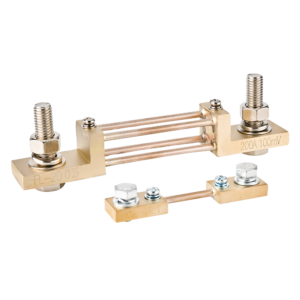
External vs Integrated Shunts
Shunts come in two main types: external and integrated. External shunts are standalone devices wired into the system, offering flexibility for custom setups. They’re ideal for off-grid systems requiring precise monitoring.
Integrated shunts, built into charge controllers or inverters, are plug-and-play but less versatile. External shunts require more setup but allow customization, while integrated shunts simplify installation.
Shunt Specifications
Choosing the right shunt depends on its specifications:
- Resistance: Typically 0.1–1 mΩ, determining the voltage drop.
- Current Rating: Ranges from 50A to 1000A, matching system size (e.g., 100A for small off-grid, 500A for large grid-tied).
- Voltage Drop: Usually 50–100 mV, ensuring minimal energy loss.
| Model Type | Current Rating | Resistance | Pros | Cons |
| High-Capacity Shunt | 500A | 0.1 mΩ | Wireless connectivity, durable | Complex setup |
| Budget Shunt | 300A | 0.25 mΩ | Easy to use | Limited features |
| Standard Shunt | 100A–500A | 0.1 mΩ | High accuracy | No wireless connectivity |
Applications of Shunts in Solar Systems
What does a shunt resistor do in solar systems? Look at some of the typical solar applications of shunt resistors.

Battery Monitoring
Shunts are vital for tracking battery health. By measuring current, they calculate SOC and state of health (SOH) for lithium-ion or lead-acid batteries.
This prevents overcharging, extends battery life, and ensures efficient energy use. For example, a shunt can alert you when a battery is nearing full charge, prompting the charge controller to reduce input.
Off-Grid vs Grid-Tied Systems
In off-grid systems, shunts are critical due to limited energy reserves. A 5kW off-grid setup in a remote area, for instance, used a shunt to manage battery loads, preventing outages during cloudy days. In grid-tied systems, shunts are supplementary, optimizing battery backup or net metering efficiency.
Integration with Smart Systems
Modern shunts integrate with IoT devices and apps. Some models offer wireless connectivity, letting users monitor SOC via smartphone for real-time insights. This addresses a gap in older articles, which rarely cover smart monitoring.
Understanding Shunt Resistance in Solar Cells
What Is Shunt Resistance in a Solar Cell?

Source: https://www.pveducation.org/pvcdrom/solar-cell-operation/shunt-resistance
Unlike shunts in solar systems, shunt resistance in a solar cell refers to an unwanted low-resistance path within the cell that diverts current, reducing efficiency.
Low shunt resistance causes power loss by allowing current to “leak” through defective areas, lowering voltage output. This is a common issue in photovoltaic (PV) performance.
What Causes Shunt Resistance in a Solar Cell?
Shunt resistance arises from:
- Manufacturing Defects: Pinholes or thin spots in the semiconductor layer.
- Material Impurities: Contaminants in silicon or other materials.
- Physical Damage: Cracks or scratches from handling.
- Environmental Factors: Shading or dust accumulation creating localized shunt paths.
Proper quality control during manufacturing can minimize these issues, but field conditions also play a role.
How to Calculate Shunt Resistance in a Solar Cell
To calculate shunt resistance (R_sh), use the formula:
R_sh = V_oc / I_sh
(V_oc is the open-circuit voltage and I_sh is the shunt current)
Steps:
- Measure V_oc and short-circuit current (I_sc) using a multimeter or solar simulator.
- Plot the current-voltage (I-V) curve to identify the shunt-dominated region (near V_oc).
- Calculate R_sh from the slope of the I-V curve in this region.
Example: A solar cell with V_oc = 0.6V and I_sh = 0.01A has R_sh = 0.6 / 0.01 = 60Ω. Lower R_sh indicates worse performance.
You can also check the shunt resistor current measurement in another article.
How to Install a Shunt in a Solar System
Tools and Materials
- Tools: Multimeter, crimping tool, wire strippers, screwdriver, heat shrink tubing.
- Materials: Shunt, battery monitor, appropriately sized cables, terminal lugs.
- Safety: Disconnect power, wear insulated gloves, and avoid short circuits.
Step-by-Step Installation Guide
- Mount the Shunt: Secure the shunt near the battery’s negative terminal, ensuring a stable, vibration-free surface.
- Connect Battery Cable: Attach the battery’s negative cable to one side of the shunt.
- Connect Load Cable: Attach the system’s ground (load) cable to the other side.
- Wire the Monitor: Connect the shunt to the battery monitor using the provided cables, following manufacturer’s instructions.
- Secure Connections: Use heat shrink or electrical tape to insulate terminals.
Calibration and Testing
Calibrate the monitor by zeroing it with no load applied. Test accuracy by comparing monitor readings to a multimeter’s current measurement. Adjust calibration if needed.
Troubleshooting Common Shunt Issues
Inaccurate Readings
- Causes: Loose connections, incorrect calibration, or monitor mismatch.
- Solutions: Tighten terminals, recalibrate, or verify shunt-monitor compatibility.
Overheating or Failure
- Causes: Undersized shunt for current load (e.g., 100A shunt in a 200A system).
- Solutions: Upgrade to a higher-rated shunt and ensure proper ventilation.
Compatibility Issues
- Causes: Mismatched shunt resistance or monitor settings.
- Solutions: Check the manufacturer specs to ensure compatibility.
Choosing the Best Shunt for the Solar System

Key Factors to Consider
- System Size: Match shunt rating to maximum current (e.g., 100A for small systems, 500A for large).
- Monitor Compatibility: Ensure the shunt works with your battery monitor.
- Features: Choose between wireless connectivity and basic models based on needs.
- Environment: Select durable shunts for harsh conditions (e.g., marine setups).
Top Shunt Models
- High-Capacity Model: Wireless-enabled, durable. Cons: Complex setup.
- Budget Model: User-friendly. Cons: Limited features.
- Standard Model: High accuracy. Cons: No wireless.
Where to Buy?
Purchase shunt resistors and other solar system electrical equipment. Come to Elehub for reliable DC electrical equipment!
Final Thoughts
Shunts are essential for solar system efficiency, measuring current flow to optimize battery performance. Meanwhile, understanding shunt resistance in solar cells helps address photovoltaic inefficiencies. Whether installing shunts, troubleshooting issues, or calculating shunt resistance, we provide detailed information for you.
Ready to enhance the solar setup of your project? Try the installation guide or explore Elehub DC current shunt models today.
FAQs
What does a shunt do in a solar system?
A shunt measures current flow in a solar system, tracking energy to and from batteries. This helps monitor battery health, prevent overcharging, and optimize performance.
What is shunt resistance in a solar cell?
Shunt resistance is an unwanted low-resistance path in a solar cell that diverts current, reducing efficiency and power output.
What causes shunt resistance in a solar cell?
Causes include manufacturing defects (e.g., pinholes), material impurities, physical damage, or environmental factors like shading.
How to calculate shunt resistance in a solar cell?
Use R_sh = V_oc / I_sh. Measure V_oc and I_sc, plot the I-V curve, and calculate R_sh from the slope near V_oc.
How is a shunt different from a Hall-effect sensor?
A shunt measures current via a voltage drop across a resistor, while a Hall-effect sensor uses magnetic fields. Shunts are more accurate but require wiring.
Can one install a shunt on his/her own?
Yes, with basic electrical skills and safety precautions. Follow our step-by-step guide for a secure installation.
What size shunt is for the solar system?
Choose a shunt rated for your system’s maximum current (e.g., 100A for small systems, 500A for large).