Power converters are essential in modern electrical and electronic systems. They change electrical power from one form to another so that a power source, load, or control system receives the required voltage, current, frequency, or waveform.
The four fundamental types are AC-DC, DC-AC, DC-DC, and AC-AC converters. AC-DC converters turn alternating current into direct current, DC-AC converters turn DC into AC, DC-DC converters change one DC voltage level to another, and AC-AC converters modify AC voltage, frequency, or related characteristics.
They are used throughout solar power systems, battery energy storage, electric vehicles (EVs), data centers, industrial equipment, and consumer electronics.
This guide explains how power converters work, the differences between the four main types, their applications, efficiency, protection requirements, and the factors to consider when selecting one.
What Is a Power Converter?
A power converter is a power-electronics device that changes electrical power from one form to another to meet the requirements of a load, power source, or electrical system.
A converter may change:
- AC to DC
- DC to AC
- One DC voltage level to another
- AC voltage or frequency
- Voltage, current, or waveform characteristics
- The direction of power flow
For example, a laptop power adapter converts AC from a wall outlet into low-voltage DC. A solar inverter converts DC generated by PV panels into AC for use by an electrical system or the grid.
The term power converter is broad. It describes the overall power-conversion function rather than one specific circuit topology.
How Does a Power Converter Work?
Most modern power converters work by controlling the flow of electrical energy through semiconductor switching devices.
A simplified conversion process is:
Input power → Switching/control → Energy storage or transformation → Filtering → Regulated output
Depending on the topology, a converter may use:
- MOSFETs, IGBTs, or other power semiconductors
- Diodes
- Inductors
- Capacitors
- Transformers
- Filters
- Feedback and control circuits
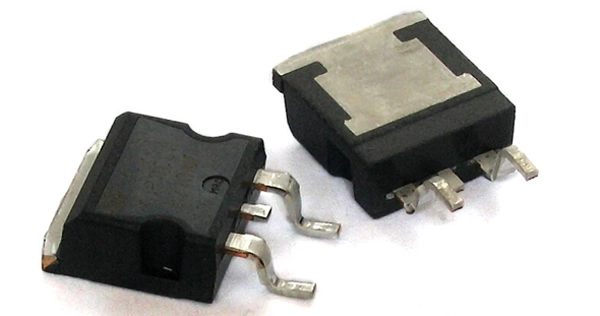
MOSFET
Source: https://commons.wikimedia.org/w/index.php?curid=706337
In a switching converter, semiconductor devices turn on and off rapidly. The controller adjusts switching operation, often through pulse-width modulation (PWM), to regulate the output.
Inductors and capacitors temporarily store and release energy, while transformers can provide voltage conversion and galvanic isolation in isolated designs.
This switching approach can provide high efficiency and allow power converters to be smaller and lighter than many traditional linear power-conversion designs.
Engineering Tip: The converter’s switching frequency is not simply a “higher is better” parameter. Higher switching frequency can reduce the size of magnetic components and filters, but it can also increase switching losses and electromagnetic interference (EMI). Converter design therefore requires a balance between efficiency, size, thermal performance, and EMI.
What Are the Four Types of Power Converters?
Power converters can be categorized according to their input and output electrical forms.
| Type | Input | Output | Common Name | Main Purpose | Typical Application |
| AC-DC | AC | DC | Rectifier | Convert AC to regulated DC | Chargers, power supplies |
| DC-AC | DC | AC | Inverter | Convert DC to AC | Solar, UPS, EVs |
| DC-DC | DC | DC | DC converter/chopper | Change or regulate DC voltage | Batteries, EVs, electronics |
| AC-AC | AC | AC | AC converter | Change AC voltage, frequency, or phase | Motor drives, industrial equipment |
The most appropriate converter depends on the electrical source, load requirements, voltage range, current, frequency, isolation requirements, and power level.
What Is an AC-DC Converter?
An AC-DC converter converts alternating current (AC) into direct current (DC).
It commonly contains a rectifier stage, but modern AC-DC power supplies may include several additional stages for filtering, power-factor correction, isolation, and regulation.
For example:
120 VAC → AC-DC converter → 12 VDC
AC-DC conversion is widely used because utility power is commonly supplied as AC, while many electronic circuits, batteries, and DC loads require DC power.
How Does an AC-DC Converter Work?
An AC-DC conversion process is:
- Voltage Conversion: The transformer steps the AC input voltage up or down to the required level.
- Rectification: A four-diode bridge rectifier converts AC into pulsating DC.
- Filtering: The capacitor stores and releases energy to reduce voltage ripple and smooth the DC.
- Regulation: The voltage regulator removes remaining fluctuations to provide a stable DC output.
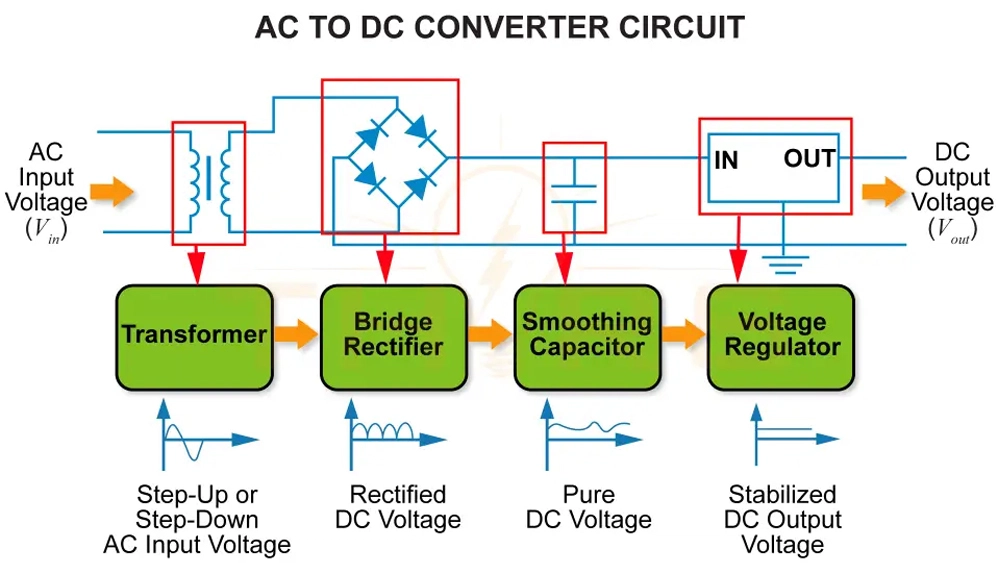
AC to DC Power Converter Circuit
Source: Thors
Types of AC-DC Converters
Common AC-DC converter types include:
- Half-Wave Rectifier: A half-wave rectifier uses one half of the AC waveform and is suitable for simple, low-power applications.
- Full-Wave Rectifier: A full-wave rectifier converts both halves of the AC waveform into a pulsating DC waveform.
- Bridge Rectifier: A bridge rectifier typically uses four diodes to perform full-wave rectification without requiring a center-tapped transformer.
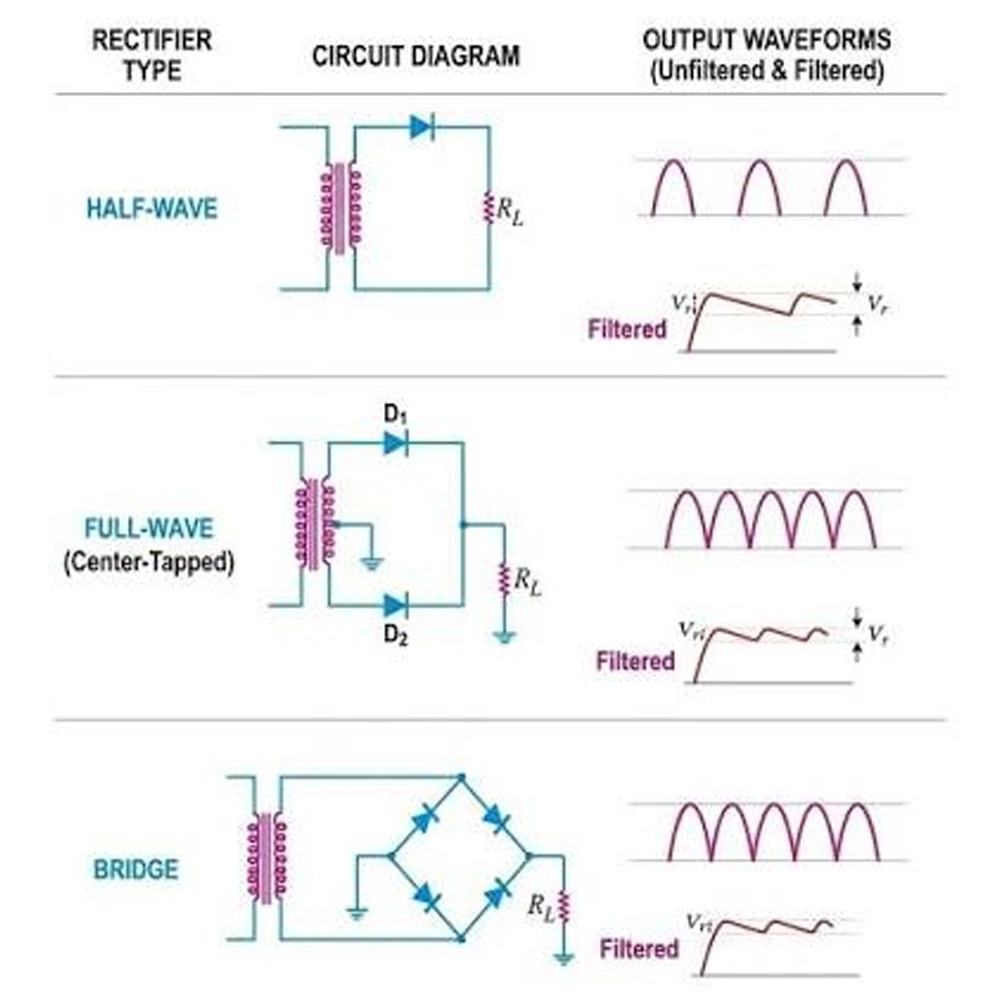
Source: Electronics Education on Facebook
AC-DC Converter Applications
AC-DC converters are used in:
- Laptop power adapters
- Smartphone chargers
- Industrial power supplies
- LED drivers
- Battery chargers
- Telecom equipment
- Data-center power supplies
- EV charging equipment
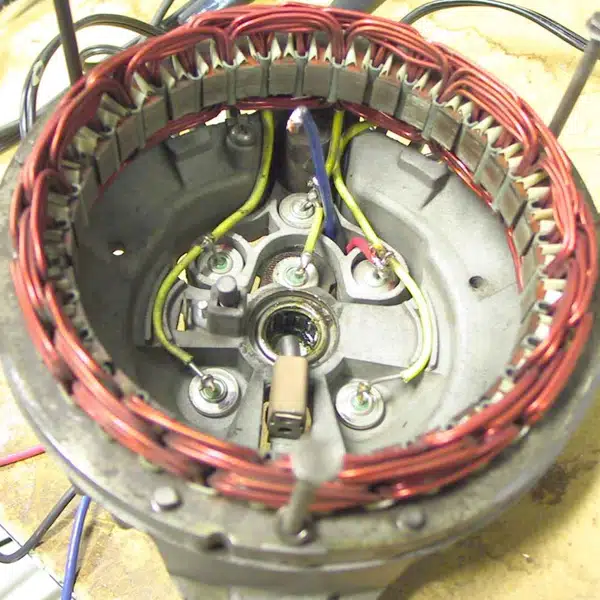
Full-wave three-phase bridge rectifier in an automobile alternator
Source: https://commons.wikimedia.org/w/index.php?curid=8989232
What Is a DC-AC Converter?
A DC-AC converter converts direct current (DC) into alternating current (AC). It is more commonly called an inverter.
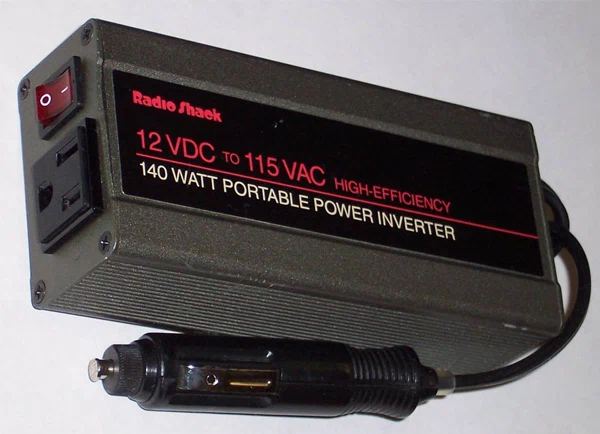
Source: https://commons.wikimedia.org/w/index.php?curid=1531403
For example:
48 VDC battery → inverter → 120 VAC
Inverters are essential when DC sources such as batteries or solar panels need to supply AC loads or interact with an AC grid.
An inverter is not simply a rectifier operating in reverse. It uses controlled semiconductor switching to synthesize an AC waveform from a DC source.
The U.S. Department of Energy explains that an inverter converts DC electricity into AC by rapidly switching the direction of the DC input; additional filtering can produce a clean sinusoidal waveform suitable for grid use.
How Does a DC-AC Inverter Work?
A simplified process is:
DC source → Semiconductor switching → AC waveform → Filter → AC output
Power switches rapidly turn on and off according to a control signal.
Through techniques such as pulse-width modulation (PWM), the inverter can control the resulting waveform.
For grid-connected applications, the inverter must also synchronize its output with the grid’s voltage, frequency, and other electrical characteristics.
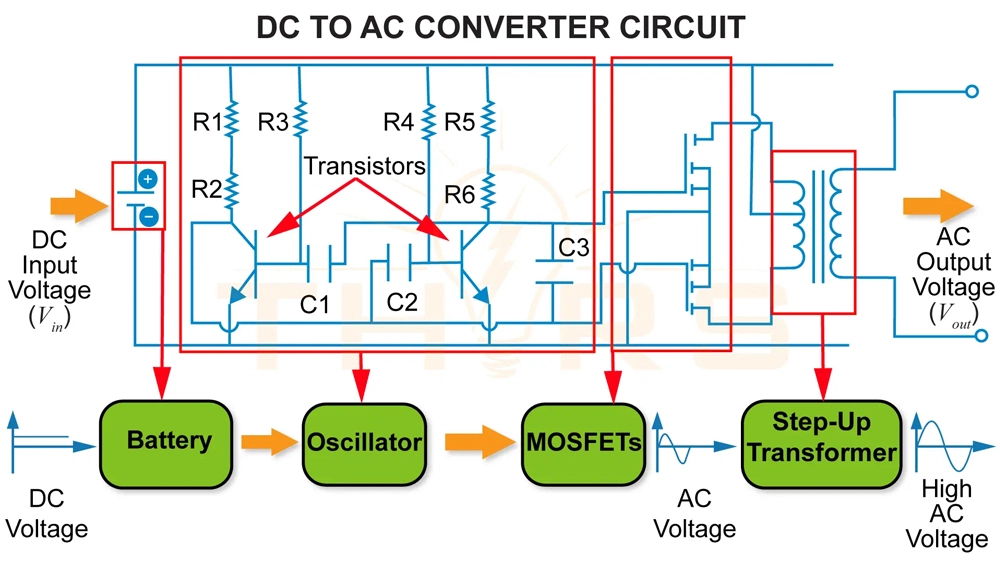
DC to AC Power Converter Circuit
Source: Thors
Types of DC-AC Inverters
Common inverter types include:
- Square-Wave Inverter: Produces a basic square-wave output and is generally used only for simple applications.
- Modified-Sine-Wave Inverter: Produces a stepped waveform that is more suitable for some AC loads.
- Pure-Sine-Wave Inverter: Produces a waveform closer to utility power and is commonly used for sensitive electronics, solar systems, and grid-connected applications.
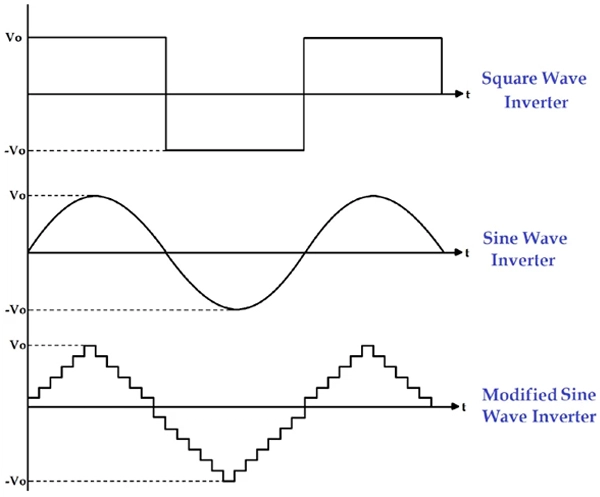
Source: Circuit Digest
DC-AC Inverter Applications
Inverters are widely used in:
- Solar PV systems
- Battery energy storage systems
- Uninterruptible power supplies (UPS)
- Electric vehicles
- Motor drives
- Off-grid power systems
- Backup power systems
For example, solar panels produce DC electricity, while conventional electrical grids distribute AC electricity. A solar inverter bridges that difference.

An inverter on a free-standing solar plant
Source: https://commons.wikimedia.org/w/index.php?curid=20349514
What Is a DC-DC Converter?
A DC-DC converter changes one DC voltage into another DC voltage.
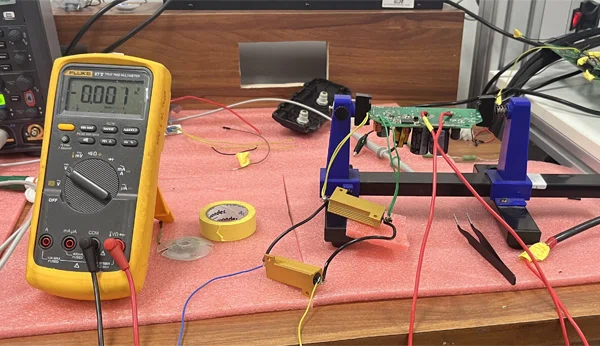
Flyback converter: 400 V to 12V DC-DC conversion
Source: https://commons.wikimedia.org/w/index.php?curid=177988435
For example:
400 VDC → DC-DC converter → 48 VDC
A DC-DC converter can:
- Step voltage down
- Step voltage up
- Step voltage up or down
- Provide electrical isolation
- Regulate a variable DC input
- Control bidirectional power flow
DC-DC converters are particularly important when the voltage of a battery, DC bus, or power source does not directly match the voltage required by a load.
How Does a DC-DC Converter Work?
Most switching DC-DC converters use a combination of:
- Semiconductor switches
- Inductors
- Capacitors
- Diodes or synchronous switches
- Control circuits
- Transformers in isolated designs
The switching device operates at high frequency, while the duty cycle controls energy transfer between the input and output. Inductors, capacitors, and other components then smooth and regulate the resulting voltage.
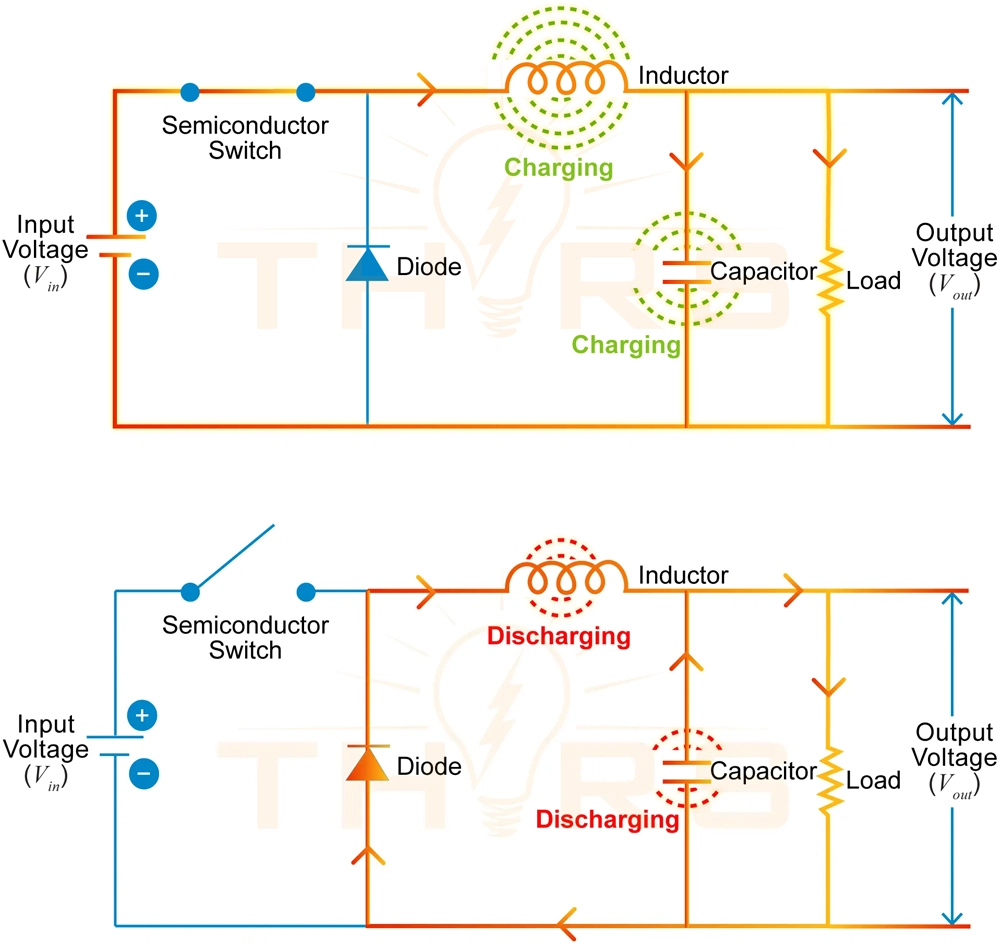
Buck Type DC to AC Power Converter Circuit
Source: Thors
Types of DC-DC Converters
- Buck Converter: Steps DC voltage down, such as converting 24 VDC to 12 VDC.
- Boost Converter: Steps DC voltage up, such as converting 12 VDC to 24 VDC.
- Buck-Boost Converter: Can step DC voltage up or down when the input voltage varies above or below the desired output voltage.
- Ćuk Converter: Can step voltage up or down while providing continuous input and output current with relatively low ripple.
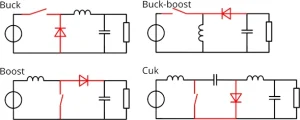
Source: https://commons.wikimedia.org/w/index.php?curid=677881
- Isolated DC-DC Converter: Provides galvanic isolation between the input and output, typically using a high-frequency transformer for safety, noise control, and system design.
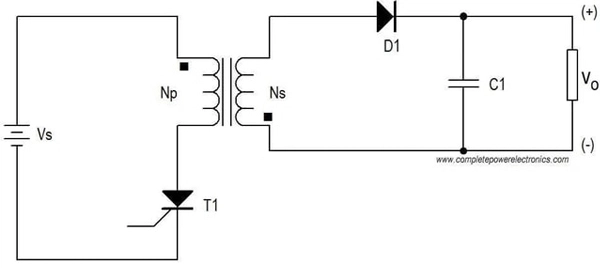
Source: How to Electronics
DC-DC Converter Applications
DC-DC converters are common in:
- Electric vehicles
- Battery energy storage
- Solar systems
- Telecom equipment
- Data centers
- Automotive electronics
- Portable electronics
- Industrial control systems
For example, modern data-center power architectures can use a high-voltage DC stage followed by a DC-DC converter to reduce the voltage to levels suitable for electronic loads.
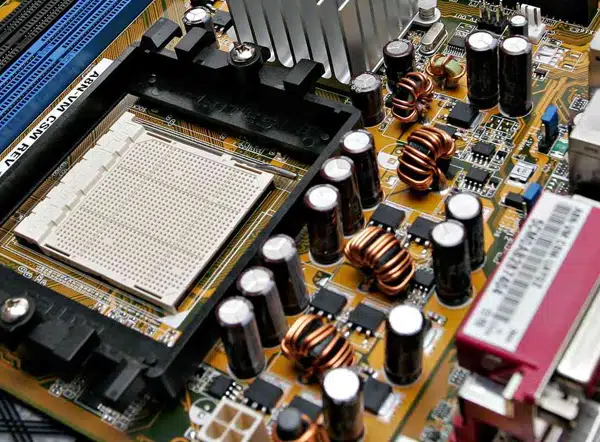
Multiphase Buck DC-DC Converter (VRM) on a Computer Motherboard
Source: https://commons.wikimedia.org/w/index.php?curid=982868
What Is an AC-AC Converter?
An AC-AC converter changes one AC electrical supply into another AC supply with different electrical characteristics. Depending on its topology, it can adjust the voltage, frequency, phase, waveform, or power flow.
For example:
480 VAC, 60 Hz → AC-AC converter → variable-frequency AC
AC-AC conversion is especially important in motor control, industrial equipment, HVAC systems, and applications requiring a different AC voltage or frequency.
How Does an AC-AC Converter Work?
An AC-AC converter uses power semiconductor switches and control circuits to modify the voltage, frequency, phase, or waveform of an AC input.
The basic process is:
AC input → Switching and control → Conversion → AC output
The controller determines how the semiconductor switches operate based on the required output characteristics and load conditions. By controlling the switching sequence and conduction time, the converter can regulate the output voltage, frequency, or waveform while maintaining the required power delivery.
Different AC-AC converter topologies use different switching methods and circuit structures, depending on the application, power level, and required output characteristics.
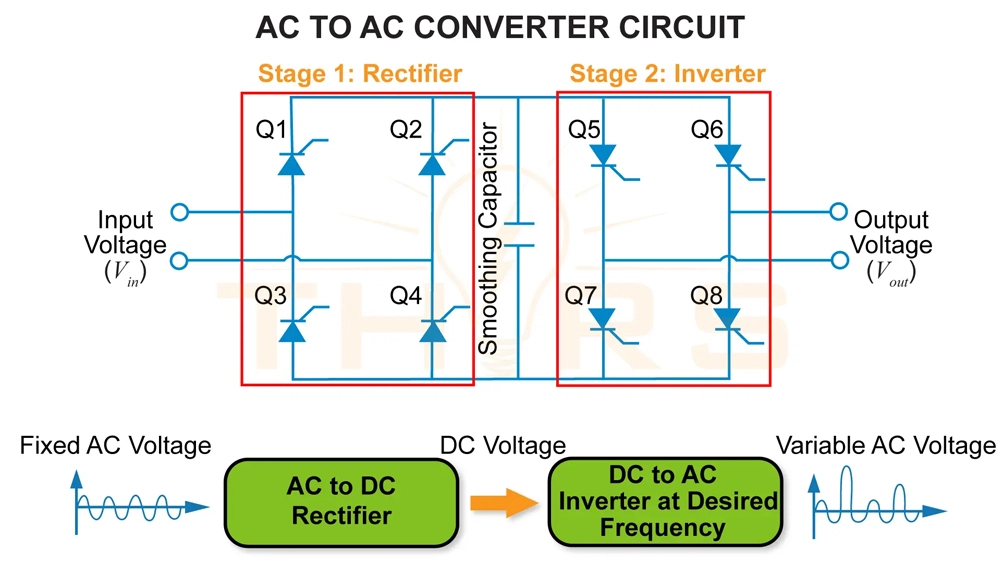
AC to AC Power Converter Circuit
Source: Thors
Types of AC-AC Converters
Common types include:
- AC Voltage Controller: Adjusts the RMS voltage supplied to a load while maintaining the fundamental frequency, commonly used for lighting, heating, and some motor-control systems.
- Cycloconverter: Directly converts AC at one frequency to AC at another frequency without a conventional DC link, mainly for high-power, low-speed motor drives.
- Matrix Converter: Uses controlled semiconductor switches to directly convert AC to AC with variable voltage and frequency without a conventional DC-link capacitor.
- AC-DC-AC Converter: Converts AC to DC and then back to AC, commonly used in variable-frequency drives for motor speed control.
AC-AC Converter Applications
Common applications include:
- Variable-frequency drives (VFDs)
- Industrial motor control
- HVAC systems
- Industrial heating
- Lighting control
- High-power motor drives
- Power-quality and frequency-conversion systems
What Is a Bidirectional Converter?
A bidirectional converter allows electrical power to flow in both directions.
This is particularly useful for batteries.
For example:
Charging: Grid → AC-DC → DC battery
Discharging: Battery → DC-AC → Grid
Bidirectional converters are increasingly important in:
- Battery energy storage systems
- Electric vehicles
- Vehicle-to-grid (V2G)
- Vehicle-to-home (V2H)
- Renewable energy systems
- DC microgrids
Power Converter vs. Transformer
A transformer and a power converter can both change voltage, but they perform different functions.
| Feature | Power Converter | Transformer |
| Changes voltage | Yes | Yes |
| Converts AC to DC | Yes | No |
| Converts DC to AC | Yes | No |
| Changes frequency | Some designs | Generally no |
| Uses semiconductor switching | Often | No |
| Can provide galvanic isolation | Some designs | Yes |
| Directly operates on steady-state DC | Some converter topologies | Conventional transformer does not |
A transformer is primarily an electromagnetic device used to transfer AC energy between circuits, commonly while changing voltage and providing isolation. A power converter uses electronic switching and control to perform more flexible power-conversion functions.
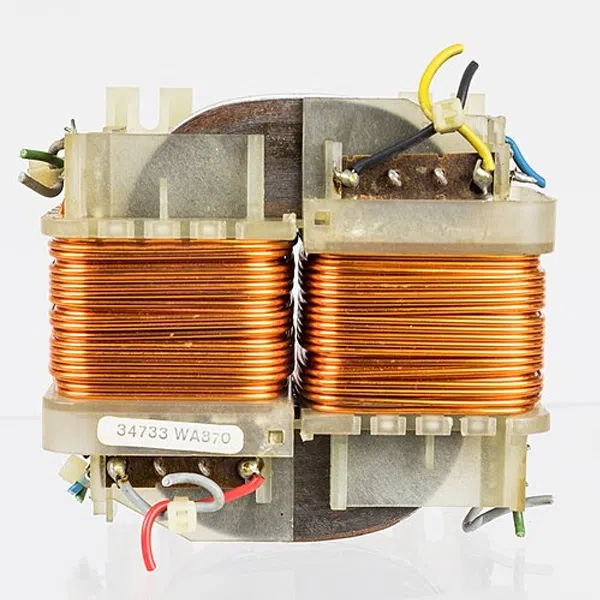
Transformer
Source: https://commons.wikimedia.org/w/index.php?curid=107320998
What Determines Converter Efficiency?
Converter efficiency describes how much of the input power is delivered to the useful output.
It can be expressed as:
Efficiency (%) = Output Power ÷ Input Power × 100
For example, if a converter receives 1,000 W and delivers 950 W:
Efficiency = 950 ÷ 1,000 × 100 = 95%
The remaining 50 W is lost through mechanisms such as:
- Semiconductor conduction losses
- Switching losses
- Transformer and inductor losses
- Capacitor losses
- Wiring and connection losses
Efficiency is not necessarily constant. It can vary with load level, input voltage, switching frequency, temperature, and operating conditions.
High efficiency is particularly important in EVs, renewable energy, battery storage, and data centers because small efficiency differences can create significant energy and cooling requirements at high power.
Where Are Power Converters Used?
Converters are found throughout modern electrical and electronic systems.
Solar Energy
A typical solar system may contain multiple conversion stages:
Solar panel DC → DC-DC conversion → DC bus → DC-AC inverter → AC grid
DC-DC conversion can optimize the PV operating point or adapt voltage levels, while the inverter converts DC power into grid-compatible AC.
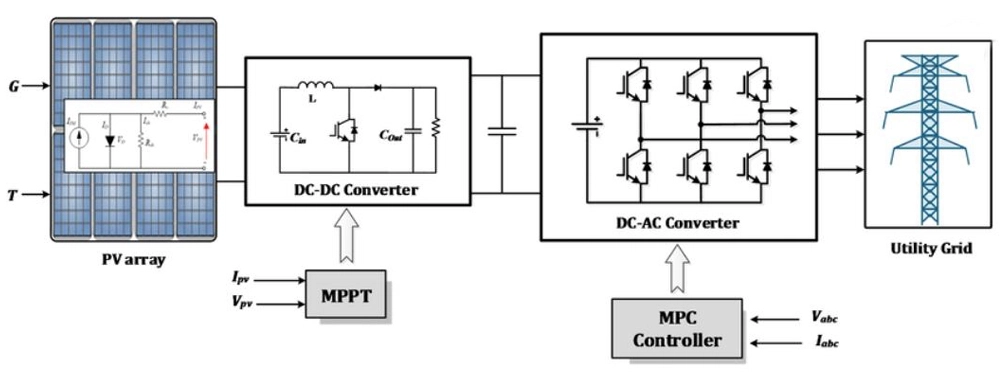
Grid-tied solar system
Battery Energy Storage
Battery systems often require several conversion stages depending on the system architecture.
A typical system may include:
Battery → DC-DC converter → DC bus → inverter → AC load/grid
The converter can regulate battery voltage and current, while the inverter handles AC power conversion.
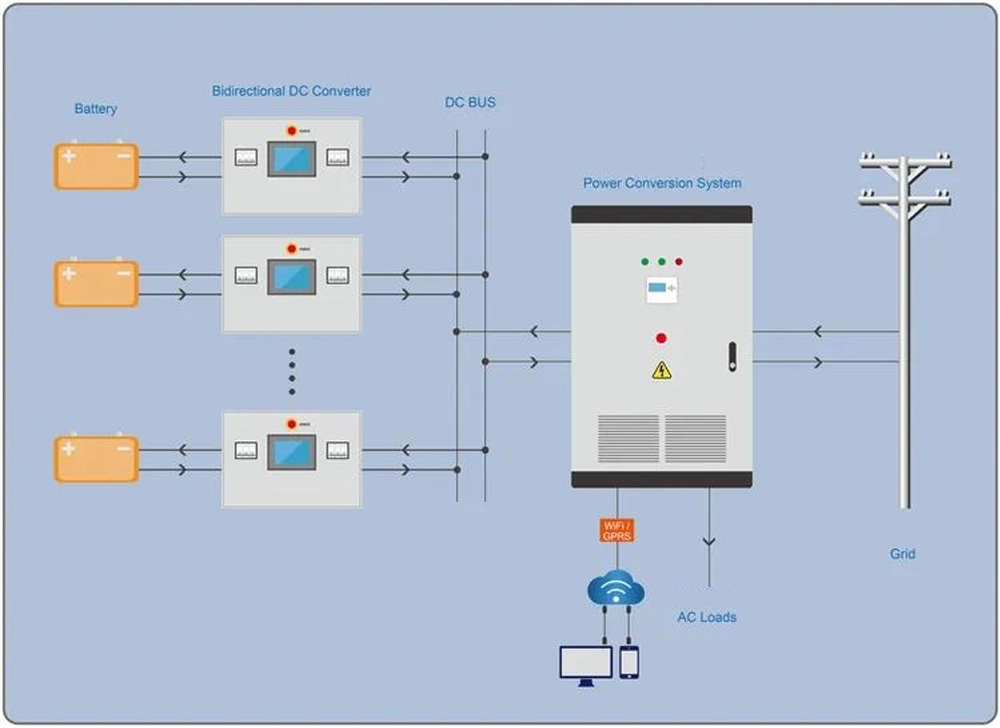
Energy Storage Battery system
Electric Vehicles
EVs use power converters throughout the vehicle.
Examples include:
- On-board AC-DC charger
- High-voltage DC-DC converter
- Traction inverter
- Auxiliary power converter
- DC fast-charging power electronics
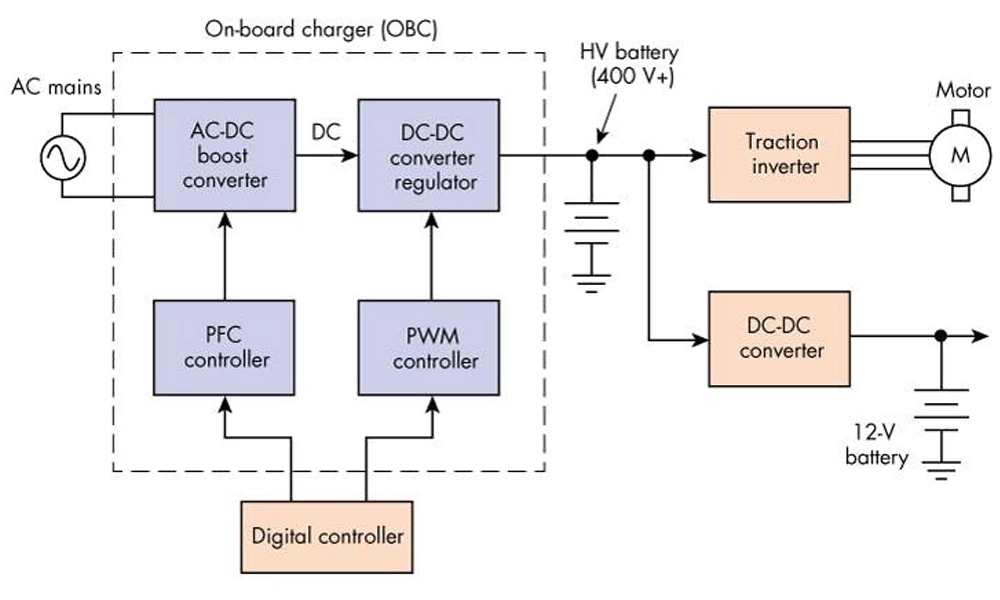
EV Power Converter System
Source: Electronic Design
Data Centers
Modern data centers may use multiple power conversion stages to distribute and regulate electrical power efficiently.
For example, AC power can be converted to a high-voltage DC intermediate bus, followed by DC-DC conversion to provide lower-voltage outputs for electronic equipment. As power demand from high-density servers and AI infrastructure grows, HVDC distribution can reduce conversion stages and improve efficiency.
Learn more about this trend in Why Data Center Power Distribution Is Moving from AC to HVDC Systems.
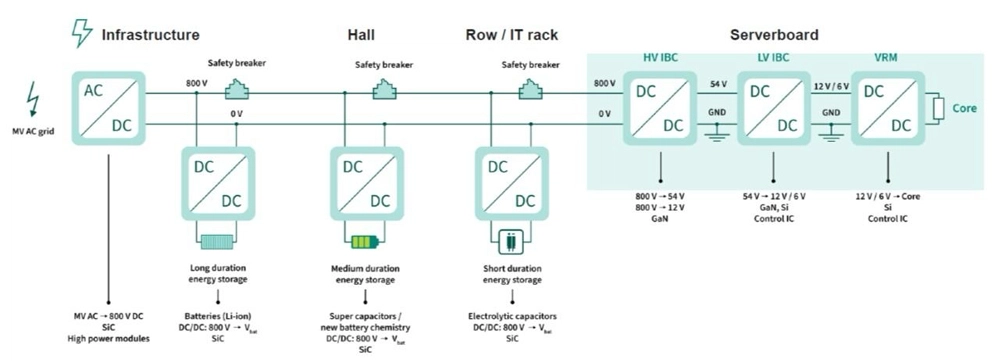
Data Center DC Power Flow Architecture
Source: Infineon
Industrial Systems
Industrial applications include:
- Motor drives
- Welding equipment
- Industrial automation
- Robotics
- Heating systems
- UPS systems
- Telecom power systems
How to Choose a Power Converter
Choosing a converter requires more than matching input and output voltage. Consider:
| Parameter | What to Check |
| Input voltage | Nominal and minimum/maximum range |
| Output voltage | Required voltage and tolerance |
| Current | Continuous and peak current |
| Power | Continuous and transient power |
| Efficiency | Efficiency at expected load |
| Isolation | Whether galvanic isolation is required |
| Cooling | Natural, forced-air, or liquid cooling |
| Protection | OCP, OVP, OTP, short-circuit, etc. |
| Environment | Temperature, humidity, altitude, vibration |
| Switching frequency | Efficiency, EMI, filtering, component size |
| Power direction | Unidirectional or bidirectional |
| Lifetime | Required operating life |
The converter should also be compatible with the system’s control architecture, environmental conditions, and required operating lifetime.
Power Converter Protection: Why It Matters
Power conversion equipment can handle substantial voltage and current. A converter therefore requires more than efficient semiconductor switching; it also needs appropriate electrical protection.
Depending on the system, protection may include:
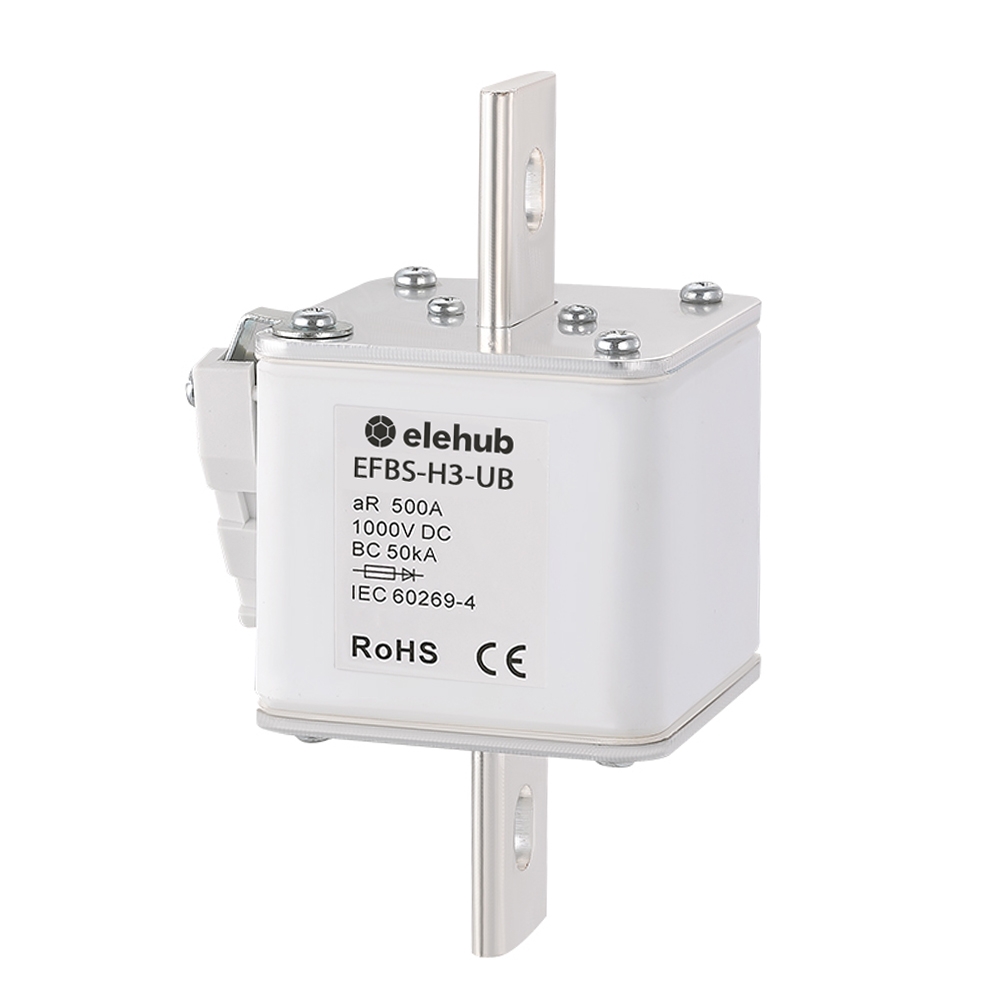
- DC fuses
- DC circuit breakers
- DC contactors
- Disconnect switches
- Surge protection devices
- Overcurrent protection
- Overvoltage protection
- Short-circuit protection
- Thermal protection
- Ground-fault protection
DC Contactors in Power Conversion Systems
A DC contactor can provide controlled connection and disconnection of a DC power circuit.

For example, in a battery system, a contactor may connect the battery to the main DC bus after system checks and precharge are completed.
This is different from simply using a semiconductor switching device inside the converter. A contactor provides an electrically isolated mechanical switching function and can be used for system-level isolation and emergency shutdown architectures.
DC Fuses and Circuit Breakers
Fuses and DC circuit breakers can protect conductors and equipment from excessive current caused by faults or overload conditions.


Selecting the protection device requires considering:
- Maximum system voltage
- Continuous operating current
- Short-circuit current
- Interrupting rating
- Ambient temperature
- DC arc characteristics
- Coordination with other protection devices
For high-voltage DC systems, protection selection is particularly important because DC current does not naturally pass through zero as AC current does, making arc interruption more challenging.
Conclusion
A power converter changes electrical power from one form to another so that a source and load can operate together efficiently and safely.
The four fundamental types are:
- AC-DC converter: converts AC to DC and is commonly called a rectifier.
- DC-AC converter: converts DC to AC and is commonly called an inverter.
- DC-DC converter: changes one DC voltage level into another.
- AC-AC converter: changes AC voltage, frequency, or other characteristics.
These technologies form the foundation of modern power electronics and are used in solar power, battery energy storage, electric vehicles, industrial automation, data centers, consumer electronics, and grid-connected systems. Power-electronics devices are increasingly important as electrical systems incorporate more renewable generation, batteries, and electronically controlled loads.
When selecting a converter, focus on the input and output voltage, current, power rating, conversion direction, efficiency, isolation, cooling, control requirements, and protection strategy rather than choosing solely by voltage.
Converter FAQs
Is an inverter a converter?
Yes. An inverter is a specific type of converter that changes DC power into AC power.
Is a rectifier a converter?
Yes. A rectifier is an AC-DC converter that changes alternating current into direct current.
Can a power converter increase and decrease voltage?
Yes. Depending on its topology, a converter can step voltage up, step it down, or regulate the output within a specified input-voltage range.
What is the difference between an isolated and non-isolated converter?
An isolated converter provides galvanic separation between input and output, while a non-isolated converter maintains an electrical connection between the two sides.
Can one system use multiple types of converters?
Yes. Complex systems commonly use multiple conversion stages. For example, an EV charging or energy-storage system may combine AC-DC, DC-DC, and DC-AC conversion.
Are power converters suitable for high-voltage DC systems?
Yes. Specialized power converters can operate in high-voltage DC systems, but component ratings, insulation, thermal management, switching losses, protection, and fault interruption must be carefully considered.