
In the current era, while approximately 8% of people don’t have access to electricity and the majority of the remaining 92% also face disruptions in electricity supply, solar energy provides a cheap, renewable, and consistent source of energy.
Solar panels generate energy during the daytime but are unable to provide sufficient energy during the early morning, evening, nighttime, or periods of cloudy weather. Solar batteries mitigate the intermittency problem of solar power generation and provide true energy independence.
This guide explains the major types of solar batteries, compares their performance, and provides practical recommendations to help you select the best battery for your solar system.
📍 Quick Comparison Table
| Battery Type | Lifespan | Efficiency | Cost | Best Application |
|---|---|---|---|---|
| Lithium-ion (LFP) | 10–15 years (4,000–10,000 cycles) |
90–98% | High | Residential solar storage, commercial energy storage, backup power |
| Lead-acid | 3–10 years (300–1,500 cycles) |
70–85% | Low | Budget solar systems, small off-grid cabins, occasional backup applications |
| Nickel-based | 20–30 years (or longer with proper maintenance) |
60–80% | High | Remote off-grid systems, harsh environments, long-life energy storage |
| Flow Battery | 20+ years (10,000+ cycles depending on chemistry) |
70–85% | High | Commercial, industrial, utility-scale solar storage, long-duration energy storage |
| Saltwater Battery | 10+ years | 80–90% | Medium-high | Environmentally focused residential and small commercial energy storage |
What Is a Solar Battery and How Does It Work?
A solar battery is a rechargeable battery that stores electricity generated by solar panels so you can use it later, instead of using it immediately or sending it to the power grid.

Source: https://www.gosunaura.com/blogs/do-you-really-need-a-solar-battery-backup-heres-what-homeowners-should-know
The process includes three main stages:
- Solar Energy Generation: Solar panels generate direct current (DC) electricity, which is readily stored in solar batteries for later use, instead of losing the excess energy produced by solar panels or exported to the electricity grid.
- Battery Charging: During the daytime, a charge controller or the battery’s built-in management system regulates the flow of current into the battery to prevent overcharging, excessive current, and high temperature.
- Battery Discharging: When a home requires more power than the solar panels are producing, the electricity stored in the battery is discharged through the inverter that converts the stored DC into alternating current (AC) for home appliances.
For example, imagine your solar panels produce 20 kWh of electricity on a sunny day:
- Your home uses 12 kWh during the day.
- The remaining 8 kWh charges the battery.
- In the evening, your home uses the stored 8 kWh, reducing or eliminating the need to draw electricity from the grid.
Solar batteries are available in many sizes, typically ranging from about 5 to 20 kilowatt-hours (kWh) of usable storage for residential homes, depending on your energy needs.
Why Solar Batteries Are Important for Solar Panels
1. Reduce Dependence on the Grid
By storing excess solar energy for later use, batteries allow homeowners to use more of the electricity they generate instead of purchasing power from the grid.
2. Increase Energy Savings
Solar panels without batteries can still lower the utility bill through net metering in many regions, but the daytime excess electricity is sold to the utility at a lower rate and bought back at night for more.
A solar battery backup system changes that math by utilizing stored energy during periods when additional power is required.
3. Provide Backup Power During Outages
Battery storage systems provide a reliable backup when the local grid fails, or the sun goes down. Battery backup for home solar setup can maintain power supply to critical loads such as refrigerators, medical equipment, and well pumps.
4. Lower Environmental Impact
Use more stored solar energy instead of fossil fuel-generated grid electricity to reduce emissions and lower your carbon footprint.
Types of Solar Batteries
The main types of solar batteries are lithium-ion, lead-acid, nickel-based, and flow batteries. Among these options, lithium-ion and lead-acid batteries dominate the residential solar energy storage market. However, battery technology continues to advance rapidly, with newer solutions offering improvements in safety, efficiency, lifespan, and scalability.
The chemistry involved in these batteries not only influences system cost, lifespan, and safety but also determines the maintenance cost for the coming years.
1. Lithium-ion Batteries
Currently, lithium-ion battery solar systems dominate the market due to their high energy density (more energy storage in a smaller volume), higher efficiency (often above 95%), and longer life cycles rated between 4000 – 10,000 cycles depending on the specific chemistry and depth of discharge.
Lithium-ion batteries include several different chemistries:
- Lithium Iron Phosphate (LFP / LiFePO₄)
- Lithium Cobalt Oxide (LCO)
- Lithium Manganese Oxide (LMO)
- Lithium Nickel Manganese Cobalt Oxide (NMC)
- Lithium Nickel Cobalt Aluminum Oxide (NCA)
- Lithium Titanate (LTO)
Among these chemistries, lithium iron phosphate (LFP) batteries have become the preferred choice for stationary solar storage applications. Although LFP batteries technically belong to the lithium-ion family, their superior thermal stability, enhanced safety, longer cycle life, and excellent tolerance to frequent charge-discharge cycles make them particularly suitable for residential and commercial solar systems.
For residential and commercial solar storage applications, LFP batteries are now widely recommended by leading manufacturers.
The main disadvantage of lithium-ion solar batteries is their higher upfront cost. Lithium solar batteries cost more per kWh than lead-acid alternatives, though the gap has considerably narrowed over the past several years, and the longer lifespan usually makes the cost-per-cycle lower over the system’s life.
📋 Pros & Cons Summary
| 👍 Pros | 👎 Cons |
|---|---|
| High energy density; stores more energy in a smaller size. | Higher upfront cost than lead-acid batteries. |
| High efficiency (typically over 95%). | Requires a Battery Management System (BMS). |
| Long lifespan (approximately 4,000–10,000 cycles). | Sensitive to extreme temperatures without proper thermal management. |
| Excellent thermal stability, especially LFP batteries. | Battery recycling is more complex than lead-acid. |
| Low maintenance requirements. | Improper charging or deep discharge may shorten battery life. |
| Higher usable capacity than lead-acid batteries. | Initial installation cost can be significant. |
2. Lead-Acid Batteries
Lead-acid solar battery systems represent established technology with low cost upfront, well-understood chemistry, and are still common in off-grid cabins and budget installations.
There are two subtypes:
- Flooded lead-acid (FLA)
- Sealed lead-acid batteries
FLA requires regular maintenance, including water top-offs and ventilation, while sealed batteries like AGM (Absorbent Glass Mat) and gel batteries are maintenance-free but carry a premium price over FLA.
The main disadvantage of lead-acid batteries is their restricted depth of discharge. Compared to lithium-ion batteries, the regular draining of lead-acid solar batteries below 50% shortens their life dramatically, whereas lithium batteries tolerate 80-100% discharge without the same penalty.
Lead-acid batteries usually exhibit life cycles in the range of 300-1500, which leads to the more frequent replacement of batteries.
For those asking whether a lead-acid battery for a solar setup is a suitable option for a solar energy system, the answer largely depends on budget and the tradeoff: the lower price for more maintenance and a shorter life span.
📋 Pros & Cons Summary
| 👍 Pros | 👎 Cons |
|---|---|
| Low upfront cost. | Shorter lifespan (typically 300–1,500 cycles). |
| Mature and proven technology. | Limited depth of discharge (usually around 50%). |
| Widely available and easy to replace. | Requires more frequent battery replacement. |
| Suitable for budget and off-grid applications. | Lower energy efficiency than lithium batteries. |
| Simple recycling process. | Flooded types require regular maintenance and ventilation. |
| Reliable performance for basic storage needs. | Larger and heavier for the same energy capacity. |
3. Nickel-Based Batteries
Nickel-based batteries, including Nickel-Iron (Ni-Fe), Nickel-Cadmium (Ni-Cd), and Nickel-Metal Hydride (Ni-MH), are mature battery technologies known for durability and long service life. Although they are less common than lithium-ion and lead-acid batteries in modern solar storage, they remain useful for specialized applications.
Among them, Nickel-Iron (Ni-Fe) batteries are the most relevant for solar energy systems because of their excellent tolerance to deep discharge, overcharging, and extreme temperatures. Some Ni-Fe batteries can operate for 20–30 years, making them suitable for remote off-grid systems and industrial applications where reliability is more important than compact size.
The main drawbacks of nickel-based batteries are lower energy density, larger physical size, lower efficiency, and higher upfront costs compared with lithium-ion batteries. As a result, they are rarely used in residential solar systems but remain a niche solution for long-life, harsh-environment energy storage.
📋 Pros & Cons Summary
| 👍 Pros | 👎 Cons |
|---|---|
| Extremely long lifespan (especially Ni-Fe batteries). | Lower energy efficiency than lithium-ion batteries. |
| Excellent tolerance to deep discharge and overcharging. | Lower energy density and larger physical size. |
| Performs well in extreme temperatures. | Higher initial cost than lead-acid batteries. |
| Highly durable with low maintenance requirements. | Less common with fewer suppliers available. |
| Suitable for remote and off-grid solar applications. | Not ideal for space-limited residential systems. |
4. Flow Batteries
Flow batteries store energy in liquid electrolyte tanks rather than solid cells, which allows capacity to be scaled independently of power output; you can add more electrolyte for more storage without changing the core system.
They’re largely used in larger commercial or community-scale solar storage rather than residential rooftops, owing to their large size and high cost, but they’re worth knowing about if you’re evaluating solar battery storage system options beyond the typical home scale.
📋 Pros & Cons Summary
| 👍 Pros | 👎 Cons |
|---|---|
| Extremely long cycle life (often 10,000+ cycles). | Large physical size and low energy density. |
| Excellent for long-duration energy storage. | Higher installation complexity. |
| Energy capacity can be expanded by adding electrolyte. | Higher upfront system cost. |
| Low risk of thermal runaway due to liquid electrolyte storage. | Requires pumps and additional components. |
| Minimal capacity degradation over long-term operation. | Not suitable for most residential solar systems. |
5. Saltwater Batteries
Saltwater batteries are an emerging energy storage technology that uses a saltwater-based electrolyte instead of the lithium-based materials found in conventional lithium-ion batteries.
Because they avoid heavy metals such as cobalt and nickel, they are considered a more environmentally friendly and safer alternative for certain energy storage applications.
The main advantages of saltwater batteries include excellent safety, non-flammable chemistry, long cycle life, and the ability to achieve deep discharge without significant battery damage. They also have a lower environmental impact and are easier to recycle compared with some traditional battery technologies.
However, saltwater batteries currently face limitations, including lower energy density, larger physical size, higher costs, and limited availability of residential products. As a result, they are not yet widely used in home solar systems but may become more competitive as the technology continues to improve.
📋 Pros & Cons Summary
| 👍 Pros | 👎 Cons |
|---|---|
| Safe and non-flammable electrolyte. | Lower energy density than lithium batteries. |
| Environmentally friendly and recyclable. | Requires more installation space. |
| Deep discharge capability. | Higher cost and limited availability. |
| Low risk of thermal runaway. | Few residential solar products available. |
What Is the Best Battery for Solar Panels?
There is no single answer to this question. Battery selection depends on the specific priorities and performance criteria being optimized.
For most modern residential solar systems, lithium iron phosphate (LiFePO₄ or LFP) batteries are considered the best overall choice because they offer a long lifespan, high efficiency, strong safety performance, and excellent usable capacity.
However, other battery types, such as lead-acid, nickel-based, and flow batteries, may still be suitable for specific applications, including off-grid systems, industrial storage, and budget-conscious installations.
📍 Best Solar Battery by Use Case
| If You Want… | Best Battery |
| Lowest cost | Flooded Lead-Acid |
| Best overall | LFP Lithium |
| Longest lifespan | Nickel-Based |
| Highest efficiency | Lithium-ion |
| Off-grid cabin | LFP / Nickel-Based |
| Whole-home backup | LFP |
| Commercial storage | Flow Battery |
| Eco-friendly option | Saltwater |
How to Choose the Right Solar Battery
Apart from battery chemistry, the following factors should be considered during the selection of the solar battery pack.
1. Capacity and Power Rating
For solar storage, battery capacity refers to the total amount of electrical energy that a battery can deliver from a full charge down to its allowable depth of discharge. Battery capacity is usually expressed in kWh.
The power rating, expressed in kW, describes how fast the battery can deliver energy at any moment.
A battery with a high energy capacity but a low power rating may struggle to supply the surge power to start high-energy-demanding appliances like air conditioners and well pumps.
2. Depth of Discharge (DoD)
A higher usable DoD allows more usable energy per cycle to be available to the consumer. For example, a 10 kWh battery designed to operate at an 80% DoD can deliver up to 8 kWh of usable energy per cycle.
3. Round-Trip Efficiency
It refers to the proportion of energy that can be recovered relative to the energy supplied during a complete charge-discharge cycle. This single number shows all energy losses in the storage systems. Lithium solar batteries outperform lead-acid batteries and give the least losses.
4. Warranty and Cell Life
When evaluating battery warranties, it is important to consider both years and cycle count because heavy daily use can exhaust the cycle life well before the warranty terms end.
5. Climate and Installation Environment
Solar battery backup must be stored in a moderate temperature (10-25 °C) and low humidity (50-60% RH). Indoor climate-controlled installations have more flexibility than exposed outdoor setups.
Can You Mix Battery Types in a Solar System?
No, Different solar battery types should not be mixed in the same battery bank.
Mixing different battery chemistries (lead-acid, lithium-ion, LFP) or even mixing batteries of different ages and capacities within the same solar battery bank causes uneven charging and discharging.
The healthier solar batteries compensate for the weaker ones. It can accelerate the degradation across the whole solar battery storage system, and it can trip safety protection in a lithium BMS that is not designed to interface with lead-acid characteristics.
To expand the existing solar battery backup system, the safest approach is to match the existing battery type, age, and capacity as close as possible or replace the entire bank rather than dissimilar units.
Solar Battery System Configurations
Solar battery setups fall into three configurations:
AC-Coupled Systems
AC-coupled systems are used where the battery has its own inverter separate from the solar inverter, converting stored DC to AC as needed. This approach is commonly used when retrofitting battery storage systems to existing solar installations.
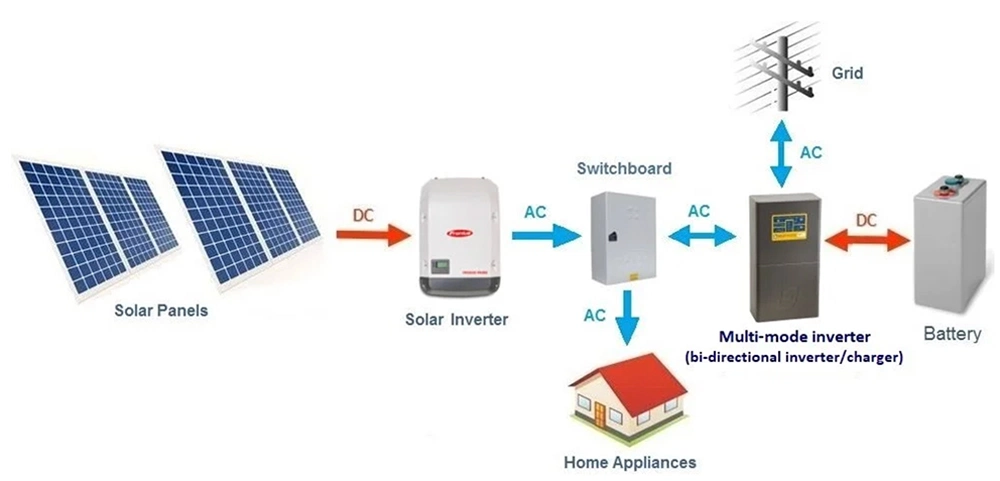
Source: https://www.cleanenergyreviews.info/blog/ac-coupling-vs-dc-coupling-solar-battery-storage
DC-Coupled Systems
DC-coupled systems are employed where a single inverter handles both the solar array and the battery. These systems offer higher efficiency since power is converted fewer times.
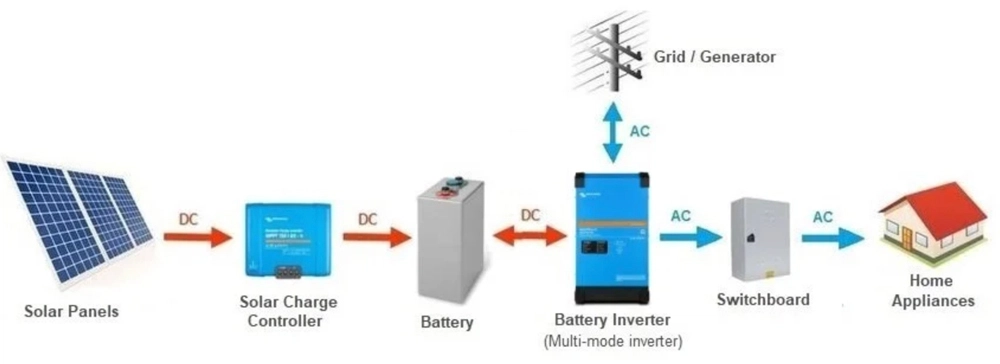
Source: https://www.cleanenergyreviews.info/blog/ac-coupling-vs-dc-coupling-solar-battery-storage
Hybrid Inverter Systems
Hybrid inverter systems combine solar charging, battery management, and grid interaction into one unit. This approach is increasing in newer residential installations because these systems reduce equipment cost and require simpler wiring.
The best configuration depends on whether the consumer is adding the solar battery system to the existing panels or designing a system from scratch.
How Long Do Solar Panel Batteries Last
Solar battery lifespan depends on battery chemistry, usage patterns, temperature, charging methods, and depth of discharge.
Typical lifespans:
| Battery Type | Typical Lifespan |
| LFP lithium battery | 10–15 years |
| Lead-acid battery | 3–10 years |
| Nickel-based battery | 20–30 years |
| Flow battery | 15–25+ years |
Solar Battery Safety Standards
Solar battery systems must comply with multiple electrical and fire safety standards depending on the installation location. In the United States, residential and commercial battery energy storage systems commonly reference:
- UL 9540: Standard for Energy Storage Systems and Equipment, covering the safety of complete energy storage systems.
- UL 9540A: Test method used to evaluate thermal runaway fire propagation risks.
- NFPA 855: Standard for the Installation of Stationary Energy Storage Systems, providing installation requirements for battery energy storage systems.
- NEC Article 706: Covers energy storage systems, including installation requirements for battery storage.
- NEC Article 690: Provides electrical requirements for solar photovoltaic systems.
👉 Further Reading: Know Different Types of PV System Certification
Solar Battery Safety and Protection
Battery banks, especially lithium ones, need more than just correct wiring; they need protection against fault conditions that the wiring alone won’t prevent.
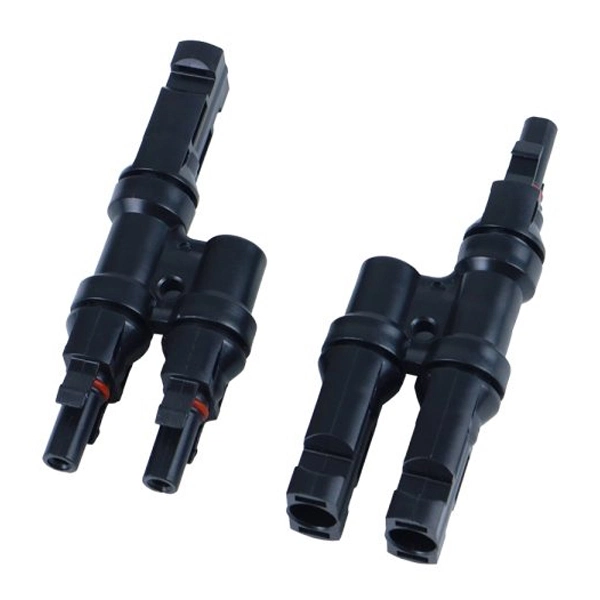
MC4 Connectors
MC4 connectors are the industry standard for connecting PV solar panels in modern solar power systems. These connectors provide a safe, reliable, weather-resistant DC connection rated to IEC 62852 with IP67/68 environmental protection.
A properly crimped and locked MC4 pair provides mechanical durability and low-resistance electrical contact under wind and vibration.
Always use genuine, matching connectors on solar panels and extension cables. Refer to our guide on connecting MC4 connectors for detailed crimping and sealing instructions.
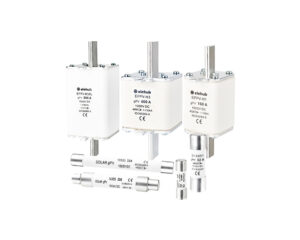
Solar Fuse
An HRC (High Rupturing Capacity) solar fuse protects the system from overcurrent by providing strong fault interruption capability and fast response in demanding DC environments.
It is essential for protecting battery banks, combiner boxes, and inverters, and must be properly sized according to the battery chemistry and expected current draw because DC fuses operate differently from AC fuses.
DC Isolator Switch
A DC isolator switch gives you a manual disconnect for maintenance, troubleshooting, or emergency shutdown; most electrical codes now require one at the battery and often at the array as well.
Learn more in our comprehensive guide covering the working principle, types, and standards of DC isolator switches.

Solar SPD Device
A Solar Surge Protection Device (SPD) protects PV systems from transient overvoltages caused by lightning strikes, grid disturbances, and switching events.
Installed on the DC side of solar arrays, battery storage systems, and inverters, a PV SPD provides a low-impedance path to divert surge energy safely away from sensitive components. This helps prevent damage to solar panels, charge controllers, inverters, battery management systems (BMS), and other electronic equipment.
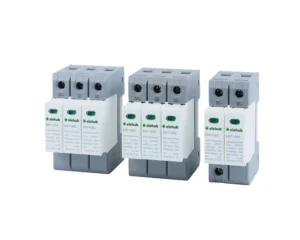
Beyond components, ventilation and thermal management matter, particularly for lead-acid banks (which can off-gas hydrogen during charging) and for lithium batteries in hot climates, where excessive heat accelerates degradation and, in rare cases, contributes to thermal runaway.
Future Trends in Solar Battery Technology
Solar battery technology is heading toward safer, smarter, and more flexible storage. Lithium batteries, especially LFP, will dominate in the near term. However, emerging technologies such as solid-state batteries, in which liquid electrolyte is replaced with solid material, offer higher energy density and improved safety.
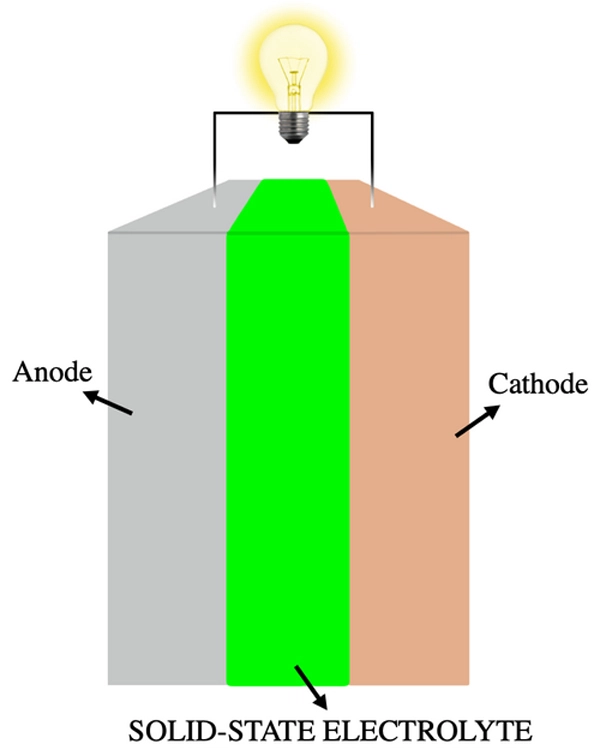
All-solid-state battery with a solid electrolyte between two electrodes
Source: By Luca Bertoli – Own work, CC BY-SA 4.0, https://commons.wikimedia.org/w/index.php?curid=91480790
Sodium-ion batteries are gaining attention as a potentially cheaper, more resource-abundant alternative to lithium as lithium supply chains face pricing pressure.
There is also growing interest in second-life batteries. Repurposing retired electric vehicles (EV) battery packs for stationary solar systems could reduce the cost of residential energy storage.
On the software side, AI-optimized smarter battery management systems combined with time-of-use optimization are increasing the value of batteries in grid-connected homes. These systems automatically determine when to charge, discharge, or draw electricity from the grid based on real-time pricing signals.
Conclusion
The selection of different types of solar batteries ultimately narrows down to matching chemistry and system design according to the consumer’s requirements. Budget, climate, backup requirements, and expected lifespan of the system before replacement are the major factors that require careful consideration.
Key Takeaways
- Lithium-ion (especially LFP) batteries are the best choice for most homes.
- Lead-acid batteries cost less but require more maintenance.
- Flow batteries are ideal for commercial energy storage.
- Battery capacity (kWh), power rating (kW), lifespan, and depth of discharge are the most important buying factors.
- Most residential systems require 10–15 kWh of storage.
Currently, lithium iron phosphate batteries offer the best combination of safety, lifespan, and efficiency and have become the practical default for residential installations. Lead-acid batteries remain a viable lower-cost entry point for smaller and budget-conscious setups.
Regardless of battery chemistry selection, proper sizing, correct wiring, adequate fusing, and surge protection are equally important. A well-protected system is essential for enabling decades-long reliable operation.
FAQs
How much do solar batteries cost?
Pricing solar batteries varies according to the chemistry, capacity, brand, and installation complexity. A lithium home battery with 10-15 kWh capacity often costs around $7000-$15000. Compared to lead-acid batteries, lithium-ion batteries usually have a higher initial cost, have a longer lifespan, and require less maintenance.
How to size batteries for solar panels?
Calculate your daily energy use, add about 20% for system losses, then choose battery capacity based on your backup goals. Most homes need 10–14kWh, while off-grid systems typically require 20–30kWh or more.
What size solar panel is needed to charge a 12V battery?
The right solar panel size depends on your battery capacity and charging speed. For a 100Ah 12V battery, a 100–200W solar panel is suitable for daily charging under good sunlight conditions.
How many solar batteries are needed to power a house?
Most homes need one to three 10–15kWh solar batteries for backup. The exact number depends on daily energy use, desired backup duration, and whether the system is grid-tied or off-grid.
How do you calculate the charging time of a battery with a solar panel?
Estimate charging time by dividing battery capacity (Wh) by the solar panel’s actual output (W), then add 20–30% for charging losses. Sunlight hours, weather, and battery condition also affect results.
Are solar batteries the same as rechargeable batteries?
Yes, all solar batteries are rechargeable, but not all rechargeable batteries are solar batteries. Rechargeable batteries power various devices, while solar batteries are designed to store solar energy, withstand outdoor conditions, support deep charge cycles, and provide backup or off-grid power solutions.
Is it worth getting a solar battery?
A solar battery is worth considering if you want backup power, lower electricity costs, and greater energy independence. The value depends on electricity rates, incentives, usage patterns, and battery lifespan.
Which solar battery lasts the longest?
Nickel-iron batteries offer the longest lifespan, often lasting 20–30 years. However, LFP lithium batteries provide the best balance of lifespan, efficiency, safety, and maintenance for most solar systems.
Can I add batteries to an existing solar system?
Yes, batteries can be added to many existing solar systems using AC-coupled or compatible hybrid inverter solutions. The system design depends on your inverter type, solar configuration, and battery compatibility.
Are lithium batteries safe for home use?
Yes, lithium batteries are generally safe for home use when properly installed with a battery management system, thermal protection, and certified equipment. LFP batteries are especially known for improved safety and stability.
How to wire a solar panel to a battery?
Connect the solar panel to a charge controller, then connect the controller to the battery. Ensure correct polarity, use proper cables, and add fuses for safe, efficient charging.


