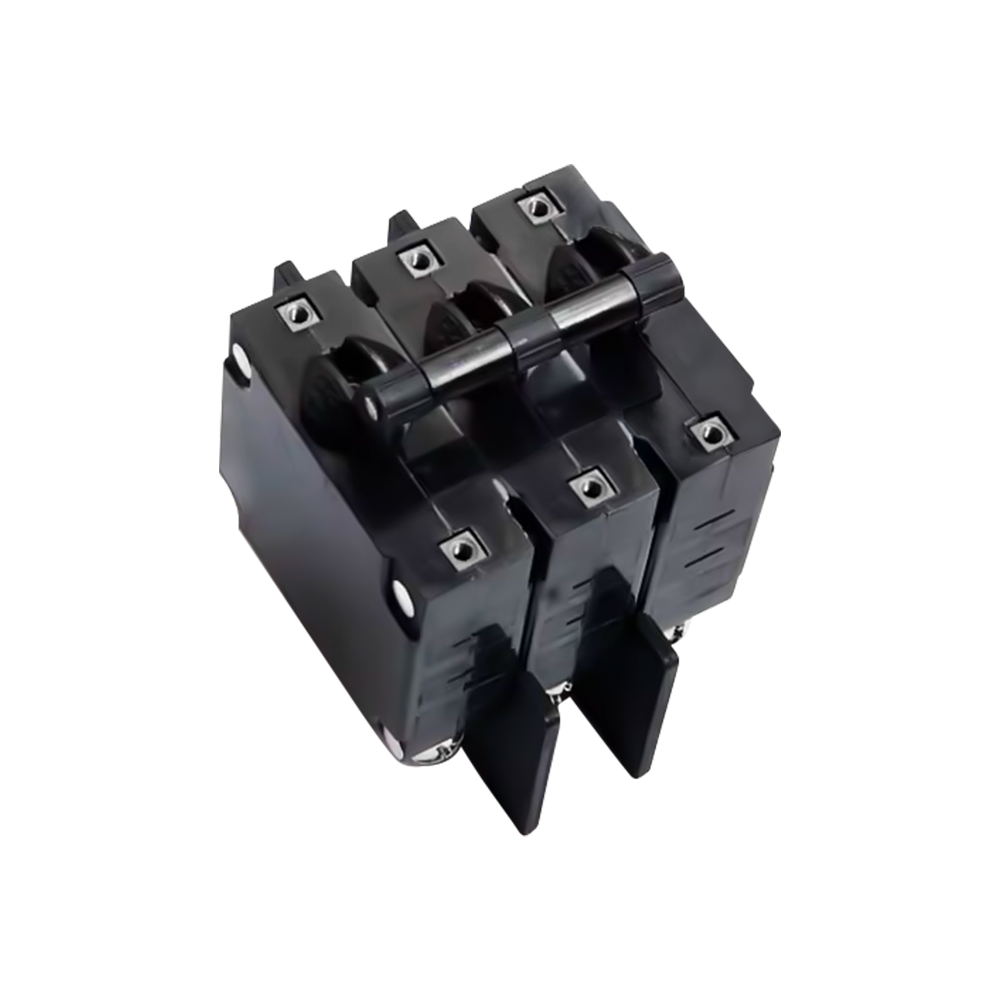
Miniature circuit breakers (MCBs) are essential in electrical systems, for they protect circuits from overloads and short circuits. Type A, B, C, and D miniature circuit breakers differ in tripping characteristics, and each suits particular uses in residential, commercial, and industrial settings.
Go on with the following content. It presents each MCB type, the technical details, real-world uses, and the selection procedure.
What Are Miniature Circuit Breakers (MCBs)?

That electromechanical switching device breaking electrical current in faults is the miniature circuit breaker. The use of an application is typically not more than 125A. Unlike AC and DC fuses, they can be reset. These are smaller as compared to molded case circuit breakers.
The operation of MCBs relies on two devices: a thermal bimetal strip, which warps with heat in the event of prolonged overloads, and a magnetic coil, which operates instantly on short circuits. MCBs are typically installed in distribution boards, with the current ratings ranging from 1A to 63A for general use, and up to 125A in special cases.
Type A, B, C, and D Miniature Circuit Breakers
Miniature circuit breakers are divided based on their tripping curves, which define their behavior in overcurrent. These curves detail the relationship between the magnitude of the overcurrent (expressed as a multiple of the MCB-rated current, In) and the time at which the breaker will trip.
These tripping curves are standardized by international standards from organizations such as the International Electrotechnical Commission (IEC) and Underwriters Laboratories (UL), ensuring similar performance across manufacturers and areas.
The concept of rated current (In) is the principle behind understanding MCB behavior, as the tripping levels of each type are specified in multiples of this rating.
| Overload Current Protection Characteristics | |||||
| Test Procedure | Type | Test Current | Initial State | Tripping or Non-Tripping Time Limit | Expected Result |
| A | B C D | 1.13ln | Cold | t≤1h | No tripping |
| B | B C D | 1.45ln | After test A | t≤1h | Tripping |
| C | B C D | 2.55ln | Cold | 1s<t<60s (ln≤32A) 1s<t<120s(ln> 32A) | Tripping |
| D | B | 3ln | Cold | t≤0.1s | No tripping |
| C | 5ln | ||||
| D | 10ln | ||||
| E | B | 5ln | Cold | t≤0.1s | Tripping |
| C | 10ln | ||||
| D | 20ln | ||||
Type A Miniature Circuit Breaker
- Tripping Range: 2-3 times rated current (example: a 10A MCB trips in the range of 20-30A).
- Applications: Protection of semiconductor circuits, sensitive electronics, and low-voltage DC systems.
- Features: Highly sensitive, MCB Type A is used in systems with minimal inrush current, such as photovoltaic inverters or telecommunication equipment. It is not commonly used since most systems have higher surge loads.
Type B Miniature Circuit Breaker

Type B MCB curves
- Tripping Range: 3-5 times rated current (e.g., a 16A MCB trips between 48-80A).
- Applications: Domestic circuits, resistive loads such as incandescent lighting, heaters, and general-purpose sockets.
- Features: Type B has average sensitivity, adequate for low transient current circuits. It is the most used type in residential installations, generally rated at 6kA breaking capacity for domestic fault levels.
Type C Miniature Circuit Breaker

Type C MCB curves
- Tripping Range: 5-10 times rated current (e.g., a 20A MCB trips between 100-200A).
- Applications: Inductive loads such as single-phase motors, fluorescent lighting, and commercial HVAC systems.
- Characteristics: C Type MCB supports moderate inrush currents. This makes MCB Type C the commonly used MCB in small-scale industrial and commercial installations. Breaking capacity is generally above 10kA to allow for a higher fault level.
Type D Miniature Circuit Breaker

Type D MCB curve
- Tripping Range: 10-20 times rated current (e.g., a 32A MCB trips between 320-640A).
- Applications: Heavy inrush appliances like three-phase motors, transformers, and welding machines.
- Characteristics: Type D breaker is the least responsive, designed for industrial applications with high startup peaks. It has to be endowed with robust circuit design due to its time lag tripping, with breaking current up to 15kA or more in heavy-duty ratings.
Comparing MCB Types: Key Distinctions
MCB types and their uses
- Sensitivity: Type A trips at the lowest overcurrent threshold (2-3x), while Type D withstands the highest (10-20x), reflecting their respective applications.
- Response Time: Per IEC standards, MCB Type A trips within 0.1 seconds at 3x In, whereas Type D can delay up to 0.04 seconds at 20x In, per magnetic trip timing.
- Cost and Availability: Type B and C are mass-produced at cheaper costs, while Type A and D, due to specialized designs, have higher prices.
- Regional Variations: MCB Type A is implemented more in European DC systems as a DC MCB circuit breaker, Type B tends to dominate North American homes, and Type D in Asian manufacturing bases.
- Temperature Sensitivity: Thermal tripping adjusts with ambient conditions—e.g., a 40°C environment may reduce tripping thresholds by 5-10%.
Technical Specifications of Miniature Circuit Breaker Types A, B, C, D (IEC)
| MCB Type | Tripping Range (as multiple of In) | Typical Applications | Typical Breaking Capacity (kA) |
| MCB A Type | 2-3x | Semiconductor circuits, sensitive electronics, low-voltage DC systems | 6 |
| MCB B Type | 3-5x | Residential circuits, resistive loads | 6 |
| MCB C Type | 5-10x | Inductive loads (small motors, fluorescent lights, HVAC) | 10 |
| MCB D Type | 10-20x | High-inrush equipment (large motors, transformers, welding) | 15+ |
How to Choose the Right MCB Type?
Accurate MCB selection requires technical evaluation:
- Evaluate Load Type: Resistive loads (e.g., heaters) need less sensitivity; inductive loads (e.g., motors) need higher tolerance.
- Set Inrush Current: Motors may have 6-8x In for 0.1 seconds; transformers can up to 15-25x In for brief periods.
- Align with Tripping Curve: Select MCB A Type for 2-3x peaks, MCB B Type for 3-5x, MCB C Type for 5-10x, or Type D for 10-20x.
- Verify Standards: Comply with IEC 60898 (household, 230/400V AC) or IEC 60947-2 (industrial, broader voltage range), plus regional codes (e.g., UL 489 for North America).
- Check whether you need a polarity or a DC non-polarity MCB.

Application Examples
- Home Circuit: A 16A MCB B Type protects a 230V lighting circuit with a 3kW load and small inrush.
- Industrial Motor: A 40A Type D MCB supports a 15kW three-phase motor with a 400A startup surge.
Common Errors
- Undersizing: A 10A Type B on a 2kW motor (8x inrush) trips prematurely.
- Oversizing: A 20A Type D breaker in a resistive 2kW circuit lags in fault response, risking cable damage.
Regulation of Miniature Circuit Breaker
IEC 60898-1: covers AC low-voltage circuit breakers of household and equivalent applications. Such MCBs find application in typical household residential, school, shop, and office electrical distribution panel switches, rated up to a maximum current of 125A and with a rated voltage of 230/400V AC at 50/60Hz.
IEC 60947-2: addresses circuit breakers for industrial use. The standard is broader in application and covers MCBs that have a greater range of voltage ratings, such as 400V, 440V, 690V, and even 1000V, and adjustable parameters to meet the specific needs of industrial equipment.
UL 489: In North America, the UL 489 test is necessary for miniature circuit breakers used inside an electrical installation to meet the national 120/240V supply grid. Current-limiting MCBs under this listing are primarily deployed in branch protection circuits in the commercial industry. Read more in What Are UL Standards: A Focus on DC Electrical Components.
Comparison of IEC 60898-1, IEC 60947-2, and UL 489 Standards for MCBs
| Feature | IEC 60898-1 (Household) | IEC 60947-2 (Industrial) | UL 489 (North American Industrial Branch Circuit) |
| Application Focus | Household and similar installations | Industrial applications | Industrial branch circuit protection |
| Max Voltage | 230/400V AC | Up to 1000V AC | 120/240V AC |
| Max Current | 125A | Typically higher than 125A | Up to 100A |
| Short-Circuit Capacity Designation | Icn | Icu | Icn |
| User Expertise | Uninstructed persons | Instructed persons | Not explicitly defined |
| Maintenance Requirements | Not meant to be serviced | Needs to be serviced | Not explicitly defined |
| Reference Temperature | 30°C | 30°C, 40°C, or 50°C (depending on compliance) | 25°C or 40°C |
| Typical Trip Curves | B, C, D | B, C, D, K, Z, MA (instantaneous trip adjustable or fixed) | Z, C, K (some B and D) |
| Key Tests | Conventional non-tripping/tripping current and time tests | Conventional non-tripping/tripping current and time tests | 135% and 100% calibration tests |
MCBs vs Fuses & MCBs vs MCCBs
MCBs vs. Fuses: MCBs reset after tripping (10-15ms reclosure), while fuses require replacement (e.g., $0.50-2 per unit). Fuses lack magnetic tripping, limiting short-circuit response.
Comparison of MCBs and Fuses
| Feature | MCBs | Fuses |
| Resetting Capability | Resettable | Single-use (requires replacement) |
| Response Speed | Generally faster | Can be slower, especially for short circuits |
| Accuracy | More precise overcurrent detection | Less precise |
| Safety of Handling | Safer for resetting | Risk of shock during replacement |
| Short Circuit Protection | Thermal and magnetic tripping | Primarily thermal, may have limitations for rapid short circuits |
| Typical Applications | Modern residential, commercial, and industrial installations | Older installations, simple circuits, high breaking capacity needs |
MCBs vs. MCCBs: MCCBs handle up to 2500A currents with adjustable trip settings (e.g., 80-100% In), compared to MCBs’ fixed curves and 125A ceiling. MCCBs suit high-voltage substations.
Comparison of MCBs and MCCBs
| Feature | MCBs | MCCBs |
| Maximum Current Rating | Up to 125A | 15A to 2500A+ |
| Maximum Voltage Rating | Typically below 1000V | Up to 2500V |
| Short Circuit Interrupting Rating | Up to 18kA | 10kA to 200kA+ |
| Trip Curve Adjustability | Fixed | Often adjustable |
| Typical Size | Compact | Larger and more robust |
| Primary Application Environments | Residential, commercial, light industrial | Large commercial, heavy industrial, medium voltage |
FAQs About MCBs
What is the least common MCB type?
Type A MCB. It is most commonly applied for low-inrush applications such as semiconductor protection.
Is C Type MCB suitable for residential use?
Yes, for mildly inrush loads (e.g., 1-2kW motors), though Type B is standard for general household circuits.
How are the tripping curves of Types A, B, C, and D MCBs different?
The tripping characteristic of an MCB indicates how it will react to overcurrent. Type A trips at 2–3 times rated current, Type B at 3–5 times, Type C at 5–10 times, and Type D breaker at 10–20 times. These types are suitable for specific loads, from sensitive electronics to high-inrush industrial loads.
Which MCB type is generally recommended for domestic applications?
For most household circuits, Type B MCBs are standard as they are moderately sensitive and appropriate for general household loads like lighting and heaters. C Type MCB can also be used in situations where moderate inrush currents from appliances are expected.
How to approach selecting the correct MCB for a particular load?
Begin by establishing the load type—resistive loads will require less sensitivity (e.g., Type B), whereas inductive loads with high inrush currents may require a Type C or D.
Also, take into consideration the expected inrush current, application environment, and applicable safety standards to ensure sufficient protection.
Are there advancements in MCB technology with smart features?
New MCBs are emerging to include IoT integration, offering real-time monitoring, diagnostics, and even remote circuit interruption control. These smart features support the growing requirements of smart grid and automation systems.
What’s the difference between fuse and circuit breaker?
A fuse is a one-time protective device that melts when current exceeds safe limits, while a circuit breaker is reusable, automatically trips to stop excess current, then can be reset safely. Read more in What are Circuit Breakers and Fuse vs Breaker.