The automotive industry regularly transforms due to the adoption of advanced systems and new components. One of the most important developments is the high-voltage power system in electric vehicles, which delivers power efficiently and safely. The high-voltage system in electric vehicles typically operates between 400 V and 800 V, supplying energy from the battery to the propulsion system and other components. To manage high-voltage power flow in EVs, the Battery Disconnect Unit (BDU) and Power Distribution Unit (PDU) play critical roles.
In this post, we will cover the high-voltage power system of EVs and explain the functions of BDUs and PDUs in power delivery. Let’s get started.

📍 Quick Summary (TL;DR)
In electric vehicles, the Battery Disconnect Unit (BDU) acts as the safety gate that connects or isolates the high-voltage battery, while the Power Distribution Unit (PDU) functions as the distribution hub, delivering power to multiple vehicle subsystems. Together, they ensure safe, efficient, and reliable high-voltage power management in EVs.
What Is a Battery Disconnect Unit (BDU) in Battery Pack?
The battery disconnect unit distributes power throughout the electric vehicle system using components such as current sensors, precharge circuits, contactors, and fuses. The EV BDU is typically located on the upper side of the battery pack or internally integrated, where it performs monitoring, activation, and deactivation of the high-voltage battery system. It essentially functions as an on/off switch, allowing the battery to operate safely in different EV modes.

BDU
How BDU Works
The BDU operates through coordinated control of contactors, precharge circuits, sensors, and protection devices:
- Precharge phase: Voltage rises gradually through a resistor to avoid inrush current
- Main contactors close: Full battery voltage is connected safely
- Continuous monitoring: Current, voltage, temperature, and isolation status
- Fault response: Contactors open or pyrofuse triggers during severe faults
Through proper configuration of breaker circuit protection, EV fuses, and BDU units, an advanced protection system is achieved. These fuses provide electric vehicle protection by offering effective overcurrent protection in high-voltage circuits.
Key Features of BDU
- High-Voltage Support: Manages voltages in the range of 400 to 800 V and supports next-generation high-voltage architectures. It is also compatible with high continuous and peak current ratings.
- Dual Contactor Design: Employs positive and negative high-voltage contactors with DC-rated arc suppression methods, providing redundant isolation for functional safety.
- Precharge System: Includes a precharge contactor and a high-power precharge resistor, enabling controlled DC bus voltage ramp-up.
- Advanced Current Sensing: Supports various current detection techniques, such as shunt-based current sensors and bidirectional current measurement, with high accuracy across different temperature ranges.
Main Components of BDU in EV
A BDU consists of several key components that work together to manage power, safety, and efficiency in electric vehicles.
High-Voltage Contactors
High-voltage contactors are heavy-duty, electrically operated switches used to manage high voltages and currents. Their main function is to connect and disconnect the battery’s positive and negative terminals.
They also control current flow during fault conditions and enable safe startup of electric vehicles.
These contactors provide double isolation in accordance with functional safety requirements (ISO 26262), and their electromagnetic design supports DC arc suppression in EV systems.

High-Voltage Contactors
Pre-Charge Contactor and Resistor
This is a key part of the BDU and is used to charge the DC link capacitor in the inverter while controlling sudden inrush current.
It protects contactors as well as other power components.
Its operation involves closing the precharge contactor, allowing current to flow through the resistor to increase the voltage until the main contactors close gradually.
Without a precharge system, inrush current can weld contactor contacts and trigger protection system faults.

Pre-Charge Contactor
Current and Voltage Sensors
The battery management system receives feedback from these sensors. Voltage sensors monitor the pack voltage and ensure safe precharging.
Current sensors measure charge and discharge current to detect overcurrent conditions.
Data from these sensors helps identify faults and ensures safe system operation.

Current Sensor
Pyrotechnic Disconnect (Pyro Fuse)
This component is used in advanced EV designs to provide high-speed circuit interruption during fault conditions. These fuses respond within milliseconds and ensure safe system operation.

Pyrotechnic Disconnect (Pyro Fuse)
Role of BDU in Electric Vehicles
The Battery Disconnect Unit (BDU) is a critical component that manages power flow, safety, and efficiency in electric vehicles.
Operating Modes Control
The BDU functions as the main on/off switch of the battery, enabling safe transitions between driving, charging, and standby modes.
Power Distribution Management
It controls and manages power distribution within the electric vehicle system to ensure stable operation.
Safety and Fault Protection
If a sudden overcurrent occurs due to a serious fault, the BDU disconnects power to prevent damage to vehicle components and ensure passenger safety.
Driving and Energy Recovery Support
The BDU not only protects the system but also ensures smooth vehicle operation. One of its key features is high power distribution efficiency. It enables fast and seamless switching between driving, charging, and regenerative braking modes.
Battery Life and System Reliability
The BDU also helps extend battery life by minimizing downtime and plays a role in fault isolation at the module level in modular battery systems.
Thermal Management
The BDU is also important for thermal management, as it helps dissipate heat during high-demand applications. This reduces component wear and maintains safe battery temperatures under high-load conditions.
Technological Innovations of BDU
Battery disconnect units are becoming more advanced and are introducing new features in electric vehicles.
They now include self-triggering circuit protection systems that quickly cut power without waiting for external commands, minimizing damage and severe faults.
Bidirectional pyrofuses are used to control faults from both directions, improving safety in complex vehicle battery designs.
What Is a Power Distribution Unit (PDU)?
The power distribution unit in electric vehicles, also known as the high-voltage power distribution box, manages power conversion and distribution to components such as the motor control unit, charging system, and battery management system.
The power distribution unit in EV supplies power to various electric vehicle loads, including traction and auxiliary systems, while protecting electrical components.
PDUs are critical in battery electric vehicle applications and are often referred to as fuse boxes. They are commonly located between the battery pack and vehicle loads, either near the battery enclosure or within the vehicle’s high-voltage electrical compartment, depending on system design.

Power Distribution Unit (PDU)
How a PDU Works
Once power is safely connected by the BDU, the PDU in EV:
- Distributes energy to traction and auxiliary systems
- Protects individual circuits using fuses and breakers
- Monitors electrical parameters and communicates with the VCU
Key Features of PDU
- Battery Contactor & Power Distribution: Operates around 400 V, provides fuse protection, manages traction inverter power, and integrates DC fast-charging contactors with precharge functionality.
- Load Isolation & Safety Monitoring: The advanced technology of circuit breakers is compatible with stable operation and safeguards against electrical disturbances. EV fuses also provide best-in-class circuit protection for advanced system-level safety for any application requirements.
ELEHUB’s circuit breaker provides strong protection for the system through fast detection and fault interruption. Their reliable features make effective fault protection in electric vehicles and renewable energy systems.
Main Components of PDU in EV
A Power Distribution Unit (PDU) efficiently manages, protects, and distributes high-voltage power across an electric vehicle’s systems.
High-Voltage Fuses
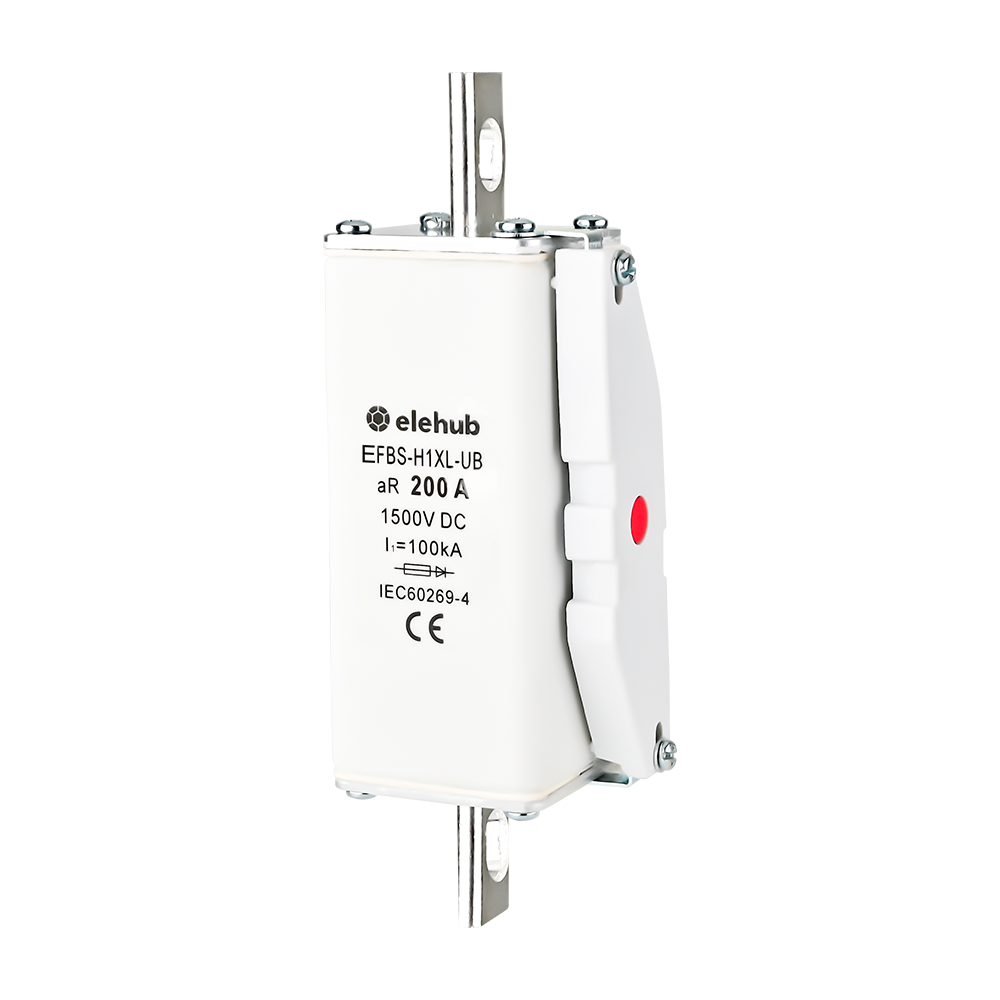
High-voltage fuses for EVs are used to control overcurrent and short circuits. They interrupt high current during fault conditions and protect cables and components from thermal damage and fire.
These fuses are designed for high DC voltages, typically in the range of 400–800 V or higher, and operate rapidly to limit fault currents. Their design enables quick DC arc interruption.

EV Fuse
Busbars
In the internal design, power distribution is achieved through busbars, which are solid metallic conductors that carry high current with low resistance. They replace multiple cables and distribute power to different circuits.
Busbars offer good thermal performance and low power loss due to their compact design. They are typically made of copper or aluminum, allowing them to handle high current and elevated temperatures efficiently.

EV Busbar
Relays or Contactors
Relays and contactors are key components of the PDU that control power delivery to specific loads and provide isolation during fault conditions.

Contactors
Current Sensors
Current sensor monitors power flow in the system by measuring load current and detecting abnormal current conditions.
They help detect and diagnose faults by communicating with the Vehicle Control Unit (VCU), enabling proper power management and protection logic.

Current Sensor
High-Voltage Connectors
High-voltage connectors provide physical connections between vehicle subsystems and the PDU.
These connectors prevent accidental contact with live conductors and ensure secure, sealed electrical connections.
They also offer high insulation resistance and electromagnetic interference (EMI) shielding.
Role of PDU in Electric Vehicles
The power distribution unit in EV is a key component that distributes high-voltage power from the battery to other components through proper power flow management. It protects against faults, monitors high-voltage current, and ensures effective operation of the motor, charging system, and other vehicle components. Some important roles of the PDU include:

BDU Location in EV
Delivering Power to High-Voltage Subsystems
Various EV systems receive power from the PDU, including the traction inverter and electric motor, onboard charger, DC-to-DC converter, thermal management system, and other high-voltage loads such as power steering and battery heaters.
Electrical Safety with Circuit-Level Protection
The PDU in electric vehicle protects each high-voltage component through high-voltage fuses that isolate faults at the subsystem level. Busbars reduce heating and resistive losses, while current sensors detect abnormal current conditions.
Simplified High-Voltage Wiring
The PDU minimizes complex wiring by reducing cable length and weight through efficient packaging, while maintaining reliable operation.
Monitoring and Control
The PDU continuously monitors voltage, current, and temperature and transmits data to the Vehicle Control Unit (VCU) for accurate operation and fault detection.
System Integration
It integrates multiple functions, including battery management, charging control, precharge circuits, and centralized system management.
BDU vs PDU: Key Differences
BDU (Battery Disconnect Unit)
|
Parameter
|
PDU (Power Distribution Unit)
|
|
|
Function
|
Makes safe connection and disconnection of the high-voltage battery in the vehicle system
|
Transmits electrical power to different vehicle subsystems
|
|
Role in Electric Vehicles
|
Provides easy and safe high-voltage isolation and battery protection
|
Provides power routing, load management, and system protection
|
|
Location in Vehicle
|
Close to the traction battery pack
|
Between vehicle loads and power supplies
|
|
Operating Voltage Range
|
High-voltage DC (200 to 1000 V DC)
|
Low-voltage (12 V/48 V) or high-voltage, depending on system design
|
|
Current Handling
|
Handles high currents from hundreds to thousands of amperes
|
Medium to high current, depending on connected loads
|
|
Components
|
Contactors, pre-charge contactor, pre-charge resistor, HV fuses, current sensors
|
Solid-state switches, fuses, relays, busbars, and current sensors
|
|
Pre-Charge Circuit
|
Yes, avoids inrush current when connecting the battery
|
No, according to upstream protection
|
|
Isolation Capability
|
Complete physical isolation of the battery from the vehicle
|
Cannot fully isolate the battery
|
|
Safety Function
|
Critical safety component
|
Secondary safety component
|
|
Fault Response
|
Opens contactors to disconnect the battery during faults
|
Isolates individual loads during faults
|
|
Control Interface
|
Battery Management System (BMS)
|
ECU, VCU, or BCM
|
|
Communication
|
CAN / LIN / HVIL signals
|
CAN / LIN / Ethernet (advanced systems)
|
|
HVIL Support
|
Yes (High-Voltage Interlock Loop)
|
supports, but not mandatory
|
|
Protection Types
|
Overcurrent, short-circuit, isolation fault, and crash detection
|
Overload, overcurrent, short-circuit per load
|
|
Loads Connected
|
Inverter, DC-DC converter, on-board charger
|
HVAC, infotainment, lighting, pumps, ECUs
|
|
Energy Management
|
Enables or disables energy flow
|
Manages energy distribution
|
|
Thermal Management
|
Heat dissipation with contactors and busbars
|
Uses cooling for high-power PDUs
|
|
Design Complexity
|
High (safety-critical design)
|
Medium to high
|
|
Reliability Requirement
|
High (ASIL-D in many cases)
|
High (ASIL-B/C typical)
|
|
Maintenance Impact
|
Rarely serviced, failure
|
Serviceable, modular in many designs
|
|
Use in ICE Vehicles
|
Not used
|
Commonly used
|
|
Use in Hybrid Vehicles
|
Yes
|
Yes
|
|
Use in Pure EVs
|
Mandatory
|
Mandatory
|
|
Cost
|
Higher due to safety-grade components
|
Moderate
|
|
Failure Consequence
|
Vehicle shutdown
|
Loss of specific subsystems
|
How the BDU and PDU Work Together in an Electric Vehicle
Both are key components of high-voltage electrical systems, especially in electric vehicles (EVs). Both perform power monitoring and distribution. Their main collective operations in EVs are as follows:
Power Distribution
Workflow: Battery → BDU → PDU → Loads
The BDU delivers power to different onboard devices such as motor control units, vehicle air-conditioning systems, and power conversion units. It ensures continuous power delivery for accurate operation and maintains system efficiency under varying load conditions.
The PDU is employed in the vehicle energy storage system to distribute energy to different devices. For effective power distribution, the PDU uses a flexible multi-port layout that supports multiple current paths based on load requirements.
Protection
Both the BDU and PDU provide effective protection for EV components through high-voltage fuses and contactors that interrupt current during short-circuit conditions, preventing device damage.
When the load current exceeds the rated value, overcurrent conditions are detected and controlled by circuit protection devices such as fuses and contactors.
Both the BDU and PDU are equipped with temperature sensors that monitor component temperatures and ensure safe operating conditions.
Monitoring
Advanced BDUs and PDUs are integrated with sensors that perform real-time monitoring of voltage and current and transmit data to control units.
These systems include alarm functions that indicate faults such as overcurrent, overvoltage, and high-temperature conditions.
Some BDUs and PDUs also use data storage systems to record operational data and provide analysis for future use.
Summary of Roles:
- BDU – Safety gate: checks battery status, ensures safe connection, protects the battery system.
- PDU – Distribution hub: allocates power to multiple subsystems, monitors load, and provides branch-level protection.
- Together – They enable safe, efficient, and intelligent high-voltage power management in EVs.
Safety, Reliability, and Performance Impact
Safety
Both the PDU and BDU manage high voltages safely and provide fault isolation.
They also support maintenance and replacement of components, offering multiple layers of protection.
Reliability Improvement
BDUs and PDUs improve system reliability by isolating faults at the subsystem level.
They reduce electrical stress on circuit components, enhancing battery durability and power control effectiveness.
Performance
Stable voltage output enables high-performance operation of the inverter and motor by minimizing electrical losses.
Proper power optimization supports fast acceleration and smooth operation, while system networking is improved through effective thermal and electrical management.
Electric Vehicle Power Distribution Unit PDU Market
According to Wise Guy Reports, the electric vehicle power distribution unit (PDU) market was valued at USD 2,000 million in 2024. It is projected to grow from USD 2,400 million in 2025 to approximately USD 15 billion by 2035. The market is expected to register a compound annual growth rate (CAGR) of around 20.1% during the forecast period (2026–2035).

From a regional perspective, North America and Europe will hold strong shares due to EV adoption and supportive policies. Asia-Pacific is expected to grow fastest, driven by rapid technological development and infrastructure expansion, while South America and the Middle East & Africa will see steady, gradual growth in electric mobility demand.
How Does ELEHUB Offer High-Voltage System Protection in EVs?
ELEHUB is renowned for protecting high-power systems using advanced technologies. ELEHUB has trusted high-voltage system protection device providers since our protection devices are fast-responding and manage overcurrent and overvoltage protection for making safe operations of electric vehicles, renewable energies, and industries.

ELEHUB’s DC electrical components are designed to fulfill industry standards and are preferred for projects where performance and reliability are needed. Our main high-voltage protection components include:
- DC Shunt
- Circuit Breakers for Enhanced Safety and Power Management
- Electric Vehicle (EV) Fuse
- Reliable High Voltage DC Contactors
Practical Tips for EV Designers & Engineers
- Always size precharge resistors for the worst-case inrush current
- Select BDUs with redundant contactors for ASIL-D systems
- Use busbar-based PDUs to reduce losses and thermal stress
- Integrate real-time sensing for predictive diagnostics
- Ensure HVIL compatibility for maintenance safety
Conclusion
Battery disconnect units (BDUs) and power distribution units (PDUs) are considered key components of high-voltage electric vehicle protection systems. The BDU primarily ensures safe battery operations and fault isolation, while the PDU delivers power to various vehicle components. Together, these units provide safe and reliable electric vehicle performance.
With that PDU, check that high-voltage subsystems like HVAC compressors, inverters, and onboard chargers get power in a safe way. By making a simple wire system provide fault isolation and make the system more reliable through accurate HV distribution.
FAQs
How does high-voltage power flow in an electric vehicle?
High-voltage power flows from the battery pack through the BDU, which connects the battery to the HV bus. From there, power goes to the PDU, which distributes it to subsystems such as the onboard charger, inverter, HVAC system, and DC-to-DC converter.
Why is the BDU needed before the PDU in an EV?
The BDU is used first to connect the battery and provide isolation. It manages precharge and fault monitoring, and if a fault occurs, it disconnects the battery from the system. The PDU then delivers power to other components after receiving it from the BDU.
What happens to high-voltage power during an EV fault?
The PDU breaker interrupts the circuit when faults occur, using relays. For severe faults, the BDU completely disconnects the battery through pyrotechnic disconnection, minimizing high-voltage exposure.
How do BDU and PDU improve EV safety?
BDU manages high-voltage faults, and PDU restricts fault effects through circuit-level protection. So both make safe power flow through, protecting users and devices, and they also follow safety standards ISO 26262 and UNECE R100.
Can an EV operate efficiently without a PDU?
No, if not, even using PDU high-voltage wires will become heavy and difficult to manage. PDUs make easy power distribution and minimize losses through providing effective energy delivery for high-voltage systems.
What is the BDU in an electric vehicle?
The battery disconnect unit distributes power in the complete electrical vehicle system. It operates like a switch that turns on and off the battery for performing different electric vehicle operations. Also, the BDU manages safety for the vehicle.
What are the common faults in BDU systems?
Common BDU faults include contactor welding caused by inrush current, precharge circuit failure, overcurrent or short-circuit events, isolation resistance faults, sensor malfunctions, and pyrotechnic fuse activation after crashes. These issues can lead to battery disconnection, system shutdown, or reduced vehicle availability if not detected and managed properly.
How to choose a PDU for a high-voltage EV?
When selecting a PDU for a high-voltage EV, consider the system voltage (400–800 V or higher), maximum continuous and peak current, number of high-voltage loads, type of circuit protection (fuses or breakers), thermal management capability, and communication interfaces with the VCU. The PDU should also comply with ISO 26262 and UNECE R100 safety standards.
Can BDU and PDU systems be modular for battery packs?
Yes. Modular BDU and PDU designs are increasingly used in modern EVs, especially in scalable battery platforms. Modular systems allow independent fault isolation, easier maintenance, flexible pack configuration, and improved manufacturing efficiency, making them ideal for electric vehicles with multiple battery modules or varying power requirements.