


Creepage vs Clearance: Key Differences in Electrical Insulation
Creepage and clearance are two fundamental measurements used in electrical insulation design. Both define the…
ELEHUB manufactures high-performance DC reversing contactors designed for reliable forward and reverse control of DC motors. Available in 100A, 200A, 300A, and 400A current ratings with 12V, 24V, and 48V DC coil voltages, our reversing contactors provide safe polarity switching for high-current DC applications.
Designed for seamless integration into electrical systems, they enhance safety and operational efficiency in motor reversing contactor setups, winch relay operations, and other high-load systems.

| Model | Image | Rated Contact Current | Max Contact Switching Voltage | Rated Coil Voltage | Contact Arrangement | Working Duty |
|---|---|---|---|---|---|---|
| EHC200I |

|
200A | ≤48VDC | 12V, 24V, 48VDC | DPDT Changeover | Intermittent |
| EHC300I |

| 300A | ≤48VDC | 12V, 24V, 48VDC | DPDT Changeover | Intermittent |
| EHC400I |

|
400A | 48VDC | 12V, 24V, 48VDC | DPDT Changeover | Intermittent |
| EHW100H-2Z |

|
100A | ≤48VDC | 12V, 24V, 48VDC | DPDT Changeover | Continuous |
| EHW200H-2Z |
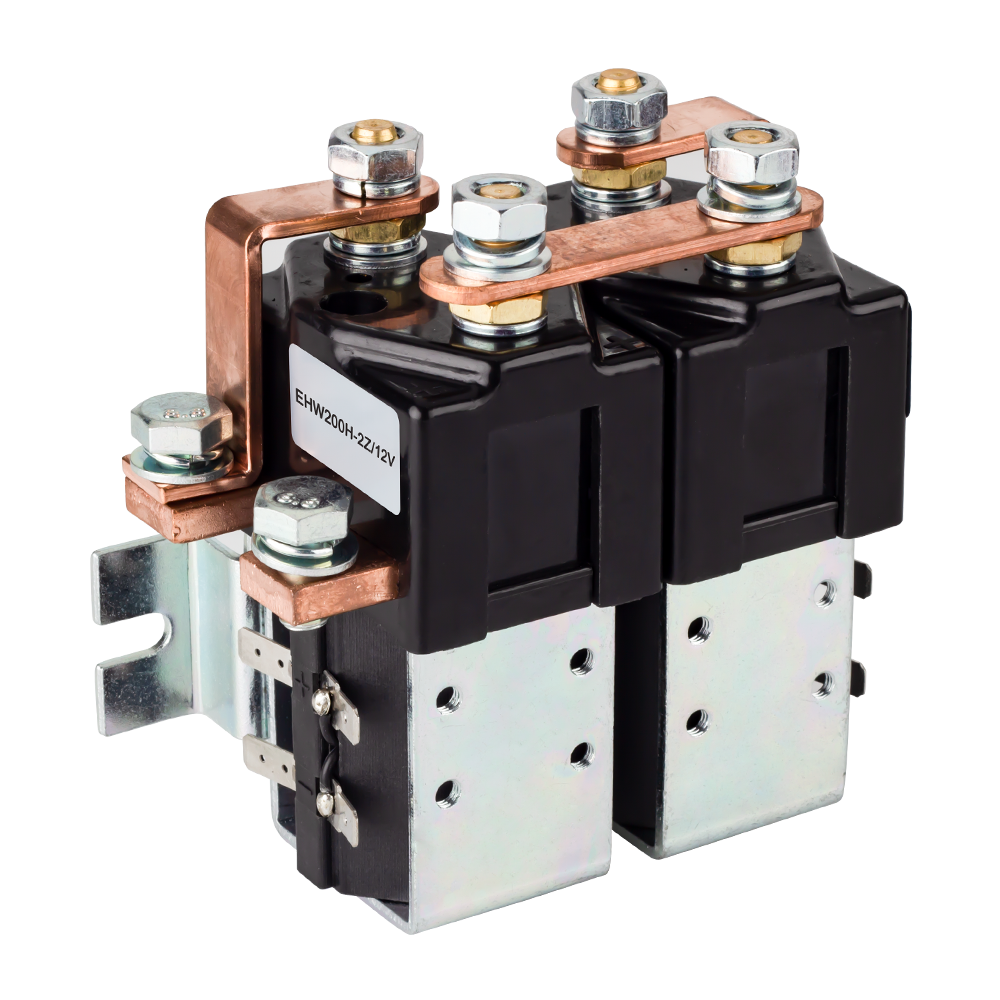
|
200A | ≤48VDC | 12V, 24V, 48VDC | DPDT Changeover | Continuous |
| EHW400H-2Z |

|
400A | ≤48VDC | 12V, 24V, 48VDC | DPDT Changeover | Continuous |
| EHWT100-2Z |

|
100A | ≤48VDC | 12V, 24V, 48VDC | DPDT Changeover | Continuous |
| EHWT200-2Z |

| 200A | ≤48VDC | 12V, 24V, 48VDC | DPDT Changeover | Continuous |
A DC reversing contactor is an electrical switching device designed to control the forward and reverse rotation of a DC motor by changing the polarity of the power supply. Unlike a standard DC contactor, which only provides ON/OFF control, a reversing contactor uses multiple contact sets to safely switch current paths and reverse motor direction.
When the control signal is applied, the contactor changes the connection between the power source and the motor, allowing current to flow in the opposite direction. This causes the DC motor to rotate backward without manually changing wiring connections.
DC reversing contactors are commonly used in applications that require frequent directional changes, including electric winches, forklifts, golf carts, off-road vehicles, AGVs, and industrial automation equipment. They are designed to handle high starting currents, frequent switching cycles, and demanding operating environments.
A DC reversing contactor typically uses two contactors or a reversing contact arrangement to safely switch the polarity of the motor power supply.
In the forward direction, the current flows through one contact path:
Battery (+) → Contactor A → Motor → Contactor B → Battery (-)
When reverse operation is required, the controller activates the reversing contactor circuit, changing the contact position and reversing the current flow:
Battery (+) → Contactor B → Motor → Contactor A → Battery (-)
The working process includes four main steps:

Basically, DC reversing contactor is used for the forward and reverse rotation of the DC motor. A non-reversing contactor only turns the motor on and off.
Non-reversing DC contactor is a SPST relay that closes the circuit when the coil is energized. It is only used for current in one direction when it is in contact. A reversing DC contactor contacts current flowing in both directions when the coil is energized. These contactors are completely different from each other.
| Feature | Reversing Contactor | Non-Reversing Contactor |
|---|---|---|
| Function | Reverses motor rotation by changing current direction. | Switches power on/off in one direction |
| Configuration | Two interlocked contactors | One contactor |
| Current Direction | Forward and reverse (bidirectional) | Fixed (unidirectional) |
| Control & Wiring | More complex control and wiring | Simple control and wiring |
| Size & Cost | Larger and more expensive | More compact and cost-effective |
| Reliability | More components, requires periodic inspection | Fewer components, lower maintenance |
| Typical Applications | Conveyors, hoists, cranes, elevators, AGVs | EV chargers, BESS, PV systems, HVAC, pumps |
| Best For | Motor forward/reverse control | Power switching and isolation |
Select a contactor based on system voltage, such as 12V, 24V, 36V, or 48V DC battery systems.
Select a contactor with a higher current rating; for example, choose a 100A contactor for an 80A motor load.
Verify the contactor can withstand the motor’s high inrush or stall current.
Select a contactor designed for the required switching frequency and operating cycle.
Consider temperature, vibration, moisture, dust, and corrosion for reliable long-term performance.
Ensure built-in or external interlocks prevent both contactors from operating simultaneously.
Choose a model that fits the available installation space and wiring layout.
Select contactors compliant with relevant IEC, UL, or other applicable industry standards.
Controls forward and reverse motor operation for smooth cable winding and unwinding under heavy loads.
Enables reliable direction switching for electric drive systems during daily vehicle operation.
Provides precise forward and reverse control for traction motors and hydraulic lifting equipment.
Supports accurate bidirectional movement for automated guided vehicles in warehouse and factory applications.
Delivers dependable motor reversing for electric utility vehicles operating in demanding environments.
Powers recovery winches with reliable forward and reverse operation for off-road rescue tasks.
Controls anchor winches and other marine DC motors with dependable polarity reversal.
Reverses conveyor, positioning, and material handling motors for automated production processes.
Enables safe lifting and lowering by reversing DC hoist and crane motor rotation.
No. A standard DC contactor only switches power on or off. Reversing motor direction requires a dedicated reversing contactor or two electrically interlocked contactors.
A mechanical interlock prevents the forward and reverse contactors from closing at the same time. This helps avoid short circuits, contact welding, excessive current, and damage to the motor or battery. For maximum safety and reliability, it is typically used together with an electrical interlock.
A golf cart reversing contactor is an essential electrical component that controls the direction of the electric motor, enabling the vehicle to move forward or backward. It acts as a high-current switch, safely routing power from the battery to the motor based on user input.
By reversing the motor’s polarity, it changes the rotation direction without requiring mechanical adjustments. Reliable operation of the reversing contactor ensures smooth acceleration, prevents electrical faults, and extends motor and battery life. It is a critical part of all electric golf carts and small EVs.
Read more about golf cart reversing contactor wiring diagram in our guide.

ELEHUB reversing contactors are available with 12V DC, 24V DC, and 48V DC coil voltages to match common battery-powered systems.
Continuous-duty contactors are designed to remain energized for extended periods without overheating, while intermittent-duty models are intended for short operating cycles with rest intervals.
Periodic inspection of terminals, wiring, contact wear, and mounting integrity is recommended to ensure reliable long-term operation and prevent unexpected failures.
Years of experience in high-current contactor production.
Long service life even under frequent switching cycles.
Sealed to resist moisture, dust, and vibration.
Fast delivery for both OEM and aftermarket customers.
Expert engineers available for integration advice.
Coil voltages and terminal configurations tailored to your needs.
Inquire Now for Innovative Wholesale Solutions!
Stay updated on the latest innovations and trends in DC electrical components.

Creepage and clearance are two fundamental measurements used in electrical insulation design. Both define the…

A conventional transformer does one job well. It changes voltage through electromagnetic induction. Yet it…

There is a possibility that a battery pack may pass its voltage tests but still…
WhatsApp us