Nowadays, solar energy is one of the most important renewable energy sources, providing clean and reliable power. Solar installations are widely used on residential rooftops and commercial buildings, making photovoltaic systems a low-cost option for power generation.
Although PV solar systems are a sustainable energy source, they can experience different types of faults and face serious risks—one of the most significant being electrical surges. Electrical surges can severely damage essential components of a solar power system, especially controllers, batteries, and inverters. Such damage can shut down the entire system and result in costly repairs.
To prevent these issues, photovoltaic surge protection is used. Surge protection devices help safeguard solar energy systems from voltage surges caused by lightning, grid faults, or transient voltages.
In this tutorial, we will explain the importance of surge protection for solar systems, how surge protection devices work, and why they are essential for maintaining safe and reliable solar power operation.
What Are Electrical Surges and Their Impact on PV Solar Systems
Electrical surges are sudden voltage spikes that travel through wiring and affect connected components. Even though surges last for a short time, they can cause severe system damage.

Sources of Electrical Surges
Some common risks or damages caused by electrical surges in solar energy systems include:
- Lightning Strikes: Lightning generates high-voltage spikes that travel through system wires. These surges can damage the entire PV solar system, including controllers, inverters, and wiring connections.
- Power Grid Faults: Faults in the electrical grid—such as voltage transients, power fluctuations, or damaged components—can create surges. These issues affect the PV system and may damage its parts.
- Internal System Faults: Internal faults within the PV system, such as wiring issues, short circuits, or damaged components, can also generate electrical surges. These transients harm different parts of the system.
- Electromagnetic Interference (EMI): EMI can produce surges in the PV system. Electromagnetic fields generated by devices such as transmitters can create transients that directly impact the solar system’s performance.
Potential Damages from Electrical Surges
- Component Failures: Inverters, controllers, batteries, and other critical parts can be permanently damaged.
- Fire Hazards: High-voltage surges can ignite system components or nearby materials.
- System Downtime and Costs: Repairs and replacements caused by surge damage can lead to prolonged outages and significant expenses.
Introduction to Photovoltaic Surge Protection
Surge protection for photovoltaic systems involves installing devices that protect electrical components from voltage transients produced by lightning or faults in the power network. Surges can cause serious damage to parts of the solar system, and the inverter is the most vulnerable component since it converts DC power from the solar panels into AC power for load operation.
Photovoltaic surge protection devices limit high-voltage spikes before they reach system components, ensuring their safety. To minimize the impact of surges, SPDs are installed at different points in the system, such as between the solar panels and the inverter, between the inverter and the power grid, and in locations where sensitive components and instruments are installed.
Types of Components for PV Surge Protection
Grounding Systems
Proper grounding is the first requirement for reducing the effects of lightning surges. A low ground resistance helps dissipate the overvoltage produced during lightning.

CC BY-SA 3.0, https://commons.wikimedia.org/w/index.php?curid=651579
Lightning Conductors
Lightning strikes on PV modules can be minimized by installing a lightning rod near the PV solar array. This rod directs lightning energy safely into the ground.

By Dual Freq at the English-language Wikipedia, CC BY-SA 3.0,
https://commons.wikimedia.org/w/index.php?curid=1383937
Surge Protection Devices (SPDs)
SPDs are used in photovoltaic systems to protect various components, such as monitoring equipment, inverters, and PV arrays.

They come in several types:
- Type 1 SPD: Installed at the main distribution or meter box, this SPD works with lightning rods to discharge high lightning currents safely to the ground.
- Type 2 SPD: Installed at the household distribution panel, it operates alone or in combination with a lightning rod. It protects the system from overvoltage and indirect lightning effects.
- Type 3 SPD: Installed near sensitive electronic devices such as TVs and computers, this SPD manages localized surges. It is typically used when devices are located more than ten meters from the Type 1 and Type 2 SPDs.
Further Reading: Surge Protection Device Types Explained: Type 1 vs Type 2 vs Type 3 SPD
SPDs use different internal components to provide protection:
- Metal oxide varistors (MOVs) dissipate excess energy and regulate voltage, making them suitable for handling high voltage spikes.
- Gas discharge tubes (GDTs) are used in high-voltage SPDs because they can safely handle and divert large surge currents to the ground.
- Transient voltage suppression diodes (TVS diodes) provide fast response to protect system components from high-speed voltage spikes.
Advantages of Surge Protection for Solar Systems
Using an accurate surge protection system provides several important benefits:
Protects devices from damage
PV surge protection devices are essential for safeguarding components like the controller, battery, and inverter from damage caused by surges. Since surges can affect the functioning of these critical and costly components, protection helps prevent the need for expensive repairs and replacements.
Improves system reliability
Solar PV systems have become more reliable since surge protection devices have been connected, which provide continuous system operations. The protected system handles any changes in the system and continuously provides power flow.
Reduces repair/replacement cost
Protection devices minimize the effect of surges, which provides component protection and reduces repair and component replacement costs. Using surge protection devices, we can minimize damage from surges without affecting performance.
Increases system lifespan
Since SPDs reduce the surges’ effect on components, this increases the overall working life of the PV system. Normally, solar systems have a longer working life, but surges affect their working life if they constantly affect the system. So the protection system ensures smooth operations and increases working life.
Maintains high energy generation efficiency
The main purpose of the PV system is to provide high energy generation with low cost, but surges affect system efficiency since they damage parts. Since SPDs reduce the surge effect on the system, which increases overall efficiency, we get continuous power generation.
Enhances overall system safety
Use of surge protection devices in PV solar systems increases the safety of components and the complete system. Surges cause electrical fires and other damages, which minimizes the use of a surge protection system and makes the overall system safer and work longer.
How to Select Surge Protection for a PV System
Different factors help us select surge protection for the PV system. Some main factors are:

System Size
If your PV system is a complicated design and has many components, it comes with a larger level of protection system. In homes and small loads, type 2 and type 3 surge protection devices are used; for industries, type 1 is used.
System Location
If a PV system is installed in an area where thunderstorms and lightning strikes are common, high-power protection devices are used for handling surges.
Voltage/Current Ratings
Use SPDs that have current and voltage ratings according to the system, which helps control surges.
Response Time
Choose a surge protection device that can control surges quickly, since highly effective surge protection devices react quickly. This helps prevent damage from voltage spikes by addressing them before they can cause harm.
Maintenance
Opt for a surge protection device with a built-in detection system that indicates when maintenance is needed. This allows for timely maintenance and ensures that any faults are addressed promptly, keeping the system in optimal working condition.
DC Surge Protection Device for Solar System
DC surge protectors safeguard control circuits and energy storage components by diverting surges safely to the ground.
Lightning strikes can affect solar panels by generating transient currents that damage panels, insulators, inverters, and other critical parts, such as the maximum power point tracker (MPPT), which is highly vulnerable to surge damage.
Therefore, using a DC solar surge protective device helps prevent these issues by reducing overvoltage and directing excess current to the ground.
A DC surge arrestor is installed on both DC and AC components. The number of DC SPDs used in a solar PV system depends on the distance between the inverter and the modules, as well as the layout of the DC line and the inverter.
The inverter is the main component of a solar PV system, and damage to it can result in costly repairs due to its complex internal circuitry. To protect the inverter and the overall system from surges, a DC surge protection device is installed.
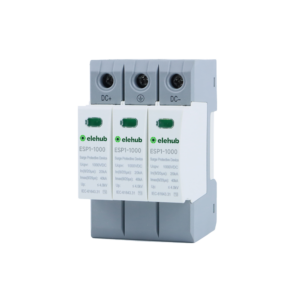
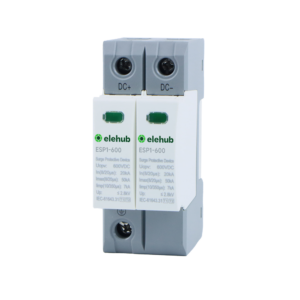
DC Surge Protection Devices in ELEHUB
ELEHUB is a leading expert in photovoltaic surge protection, offering products designed to protect solar power systems from electrical surges. Our SPDs are highly reliable, and DC surge protectors prevent surges from reaching sensitive components used in PV systems. Their high-quality materials and design ensure effective suppression of transient voltages.

Some commonly available DC surge protection devices include:
| Model |
 |
 |
 |
|
Rated Voltage
|
1500VDC
|
1000VDC
|
600VDC
|
|
Poles
|
3-Pole
|
3-Pole
|
2-Pole
|
|
Lighting Impulse Current (Iimp)
|
7kA
|
7kA
|
7kA
|
|
Nominal Discharge Current (In)
|
20kA
|
20kA
|
20kA
|
|
Maximum Discharge Current (Imax)
|
50kA
|
50kA
|
50kA
|
|
Installation
|
35mm DIN Rail
|
35mm DIN Rail
|
35mm DIN Rail
|
PV System Lightning Protection Techniques
Different protection methods are used for PV systems, and they are explained below:
Shielded Lightning Protection Method
If the system does not require separation between PV wiring and the lightning protection system, a combined and interconnected protection system is used.
This design includes a lightning protection system along with shielding that reduces electromagnetic interference (EMI).
Key elements of this method include:
- The use of shielded cables to reduce electromagnetic field interference and prevent EMI.
- Shielded electronic components that minimize electromagnetic interference and improve system reliability.
Lightning Protection Without Shielding
In this method, the PV system uses lightning protection measures without shielding for EMI reduction.
It focuses mainly on preventing lightning strikes and controlling voltage surge effects.
Its main components include:
- Arrestors and SPDs for safe dissipation of lightning current and voltage surges, protecting sensitive components.
- Grounding of metallic parts to reduce the risk of lightning current damage.
PV System Without Lightning Protection
A PV system without lightning protection is highly vulnerable to surges and lightning effects. It has a higher risk of various forms of damage, such as:
- Serious damage to PV modules installed on rooftops due to lightning strikes.
- Fire hazards are caused by lightning in the absence of protection.
- Induced voltages affecting electrical components.
- Safety risks for individuals near the PV system when lightning strikes.
Conclusion
PV systems are exposed to several risks, including induced lightning and direct lightning strikes. To ensure safe operation, different protection measures are used, such as grounding systems, lightning rods, and SPDs.
By using SPDs and other protection devices, we can protect the system from lightning strikes and voltage surges. Regular inspection, proper maintenance, and professional consultation—such as from ELEHUB—help PV systems operate reliably under different environmental conditions.
Our DC SPDs are developed under strict quality control standards to ensure they meet industry requirements for effective surge protection. Contact ELEHUB today for expert guidance on protecting your solar PV system.