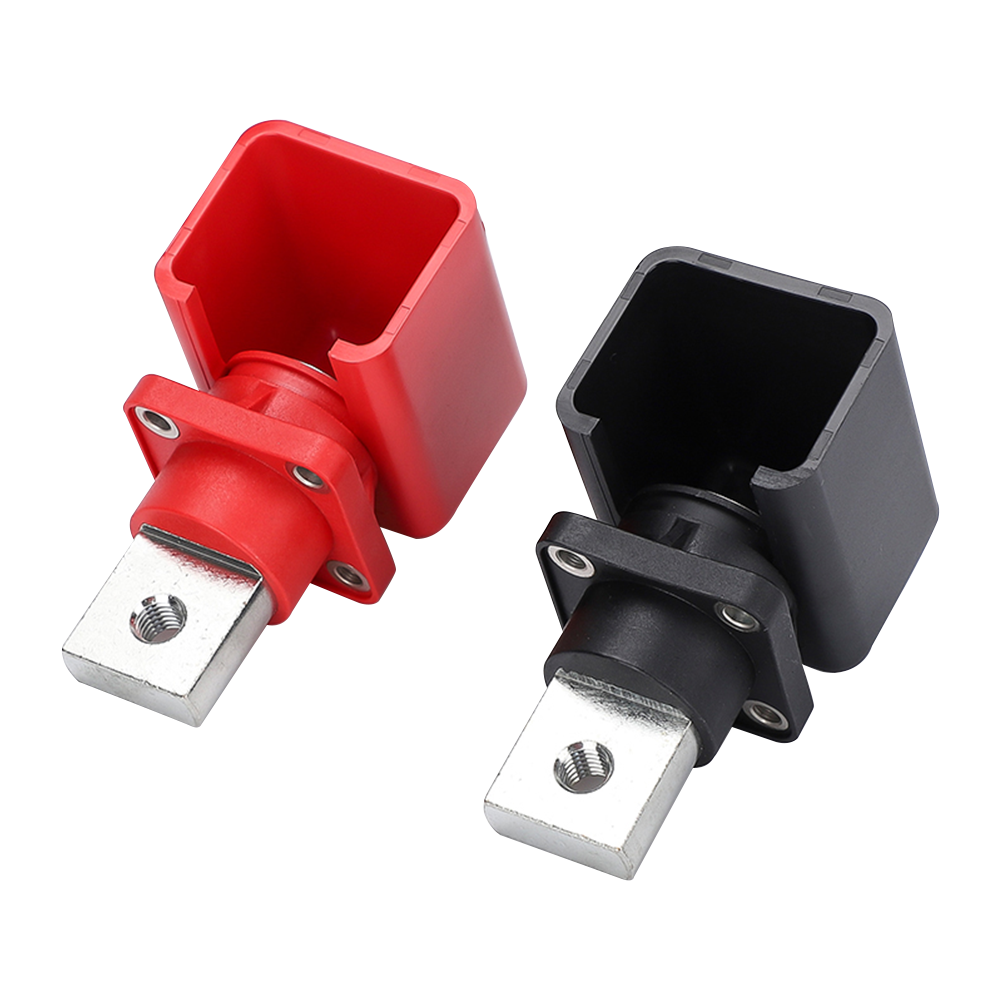
Not all circuit breakers respond to overcurrent in the same way. Understanding the differences between a Hydraulic Magnetic vs Thermal Circuit Breaker is essential when selecting the right protection device for an electrical system.
Thermal breakers detect overcurrent through heat generated in a bimetal strip, while hydraulic magnetic breakers use electromagnetic force combined with a hydraulic delay mechanism. These different sensing technologies result in differences in trip accuracy, temperature performance, response time, and application suitability.
This article compares how hydraulic magnetic and thermal circuit breakers work, explains their trip characteristics, and helps you choose the right circuit breaker protection solution for your application.
What Is a Hydraulic Magnetic Circuit Breaker?
A hydraulic magnetic circuit breaker (HMCB) is an electromechanical overcurrent protection device that uses electromagnetic sensing and a hydraulic time-delay mechanism to detect and interrupt abnormal current conditions.
Unlike thermal breakers, HMCBs sense current through magnetic force rather than heat accumulation, allowing them to maintain stable and repeatable trip performance across a wide temperature range. This makes them suitable for demanding applications such as telecom power systems, battery energy storage systems (BESS), marine equipment, aerospace, railway systems, and industrial DC distribution.

Main Components
| Component | Function |
| Electromagnetic Coil | Generates magnetic force proportional to current |
| Armature | Responds to magnetic field movement |
| Hydraulic Dashpot | Delays armature movement during overload |
| Trip Mechanism | Releases contact latch |
| Arc Chute | Extinguishes arc during interruption |
| Contacts | Carry and interrupt current |
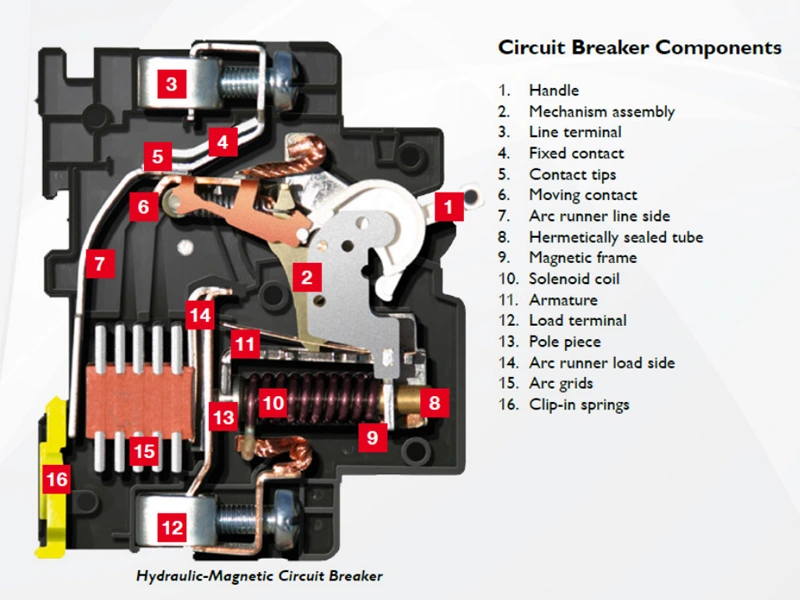
How Does a Hydraulic Magnetic Circuit Breaker Work?
A hydraulic magnetic circuit breaker operates through three basic stages:
- Normal Operation: Current flowing through the coil produces only a weak magnetic field, insufficient to move the armature. The contacts remain closed and power flows normally.
- Moderate Overload: When current exceeds the rated value, increased magnetic force moves the armature through the hydraulic dashpot. The hydraulic delay provides an inverse time response, allowing short-duration overloads to pass without immediate tripping.
- Severe Fault: When current rises several times above the rated value, magnetic force becomes strong enough to overcome the hydraulic delay. The breaker trips almost instantaneously to clear short circuits before equipment damage occurs.
- Arc Interruption: As the contacts separate, an electrical arc forms between them. The arc chute divides and cools the arc until it is extinguished, safely interrupting the circuit.
Advantages
- Stable Trip Performance: Magnetic sensing provides consistent trip characteristics across temperature variations, ensuring reliable protection in demanding operating environments.
- Excellent Inrush Current Tolerance: The controlled trip characteristics make HMCBs suitable for applications with high startup currents, including motors, transformers, and switching power supplies.
- High Protection Accuracy: Electromagnetic sensing delivers repeatable trip performance for sensitive electronics and critical power systems.
- Suitable for AC and DC Systems: HMCBs support both AC and DC applications, including telecom, BESS, EV charging, and industrial systems.
Limitations
- Higher Cost: More complex electromagnetic and hydraulic components increase manufacturing costs compared with thermal breakers.
- Larger Footprint: Additional internal components may result in a larger size than basic thermal breakers.
- Limited Availability: HMCBs are mainly used in specialized industrial and commercial applications rather than general residential markets.
- More Complex Selection: Proper selection requires evaluation of trip curves, voltage ratings, current ratings, and system requirements.
What Is a Thermal Circuit Breaker?
A thermal circuit breaker is an overcurrent protection device that uses heat generated by excessive current to interrupt an electrical circuit.
It operates through a bimetal strip made of two metals with different expansion rates. When current increases, heat generated through the I²R effect causes the strip to bend and activate the trip mechanism.
Because thermal breakers depend on heat accumulation, their response can vary with ambient temperature and operating conditions. They are commonly used in residential circuits, appliances, and general low-power electrical systems.
Main Components
| Component | Function |
| Bimetal Strip | Detects overload current by bending as it heats up. |
| Trip Mechanism | Releases the latch to open the breaker during an overload. |
| Electrical Contacts | Conduct current and separate to interrupt the circuit. |
| Operating Handle | Allows manual switching and breaker reset after tripping. |
| Arc Chute | Extinguishes the arc formed when the contacts open. |
| Terminal Connections | Connect the breaker to the incoming and outgoing conductors. |
How Does a Thermal Circuit Breaker Work?
A thermal circuit breaker operates through three basic stages:
- Normal Current Operation: Under normal current conditions, the bimetal strip remains cool enough to retain its original shape, allowing the breaker contacts to stay closed.
- Heat Generation: When current exceeds the rated value, heat is generated according to the I²R principle (Joule heating). The bimetal strip gradually heats up and bends because the two metals expand at different rates. Larger overload currents generate more heat and accelerate the bending process.
- Circuit Interruption: Once the bimetal strip bends to the calibrated trip point, it activates the release mechanism. The contacts separate to interrupt the circuit and protect connected equipment.
Advantages
- Simple and Reliable Design: Thermal breakers have a straightforward structure with fewer components, making them reliable and easy to manufacture.
- Lower Cost: Compared with hydraulic magnetic breakers, thermal circuit breakers provide affordable protection for basic electrical applications.
- Easy Installation and Maintenance: Thermal breakers are widely available and compatible with common electrical distribution systems.
Limitations
- Temperature Sensitivity: Because thermal breakers rely on heat accumulation, ambient temperature affects their trip performance. Hot environments may cause earlier tripping, while cold environments may delay protection.
- Slower Overload Response: Thermal breakers require time for heat accumulation before tripping, making them less suitable for applications requiring fast response.
- Limited Precision: The trip characteristics may vary depending on installation conditions and surrounding temperature.
Hydraulic Magnetic vs Thermal Circuit Breaker: Key Differences
| Feature | Hydraulic Magnetic Circuit Breaker | Thermal Circuit Breaker |
| Protection Principle | Magnetic sensing with hydraulic delay | Heat-based bimetal trip |
| Trip Method | Electromagnetic force | Thermal expansion |
| Temperature Influence | Minimal | Strongly affected |
| Trip Accuracy | High and consistent | Changes with environment |
| Response Time | Controlled by trip curve | Depends on heat buildup |
| Startup Current Handling | Excellent | May cause nuisance tripping |
| Harsh Environment Performance | Excellent | Limited |
| Protection Stability | Stable over wide temperature ranges | Varies with temperature |
| Cost | Higher | Lower |
| Typical Applications | Industrial, telecom, aerospace, DC systems | Residential and general electrical systems |
Circuit Breaker Trip Curve Comparison
A circuit breaker trip curve shows the relationship between overcurrent magnitude and the time required for the breaker to interrupt the circuit. It helps engineers select the right protection device based on load characteristics and fault conditions.

Time till trip versus current as multiple of nominal current
Source: By Biezl – This file was derived from: Standard-Auslösekennlinie.svg, Public Domain, https://commons.wikimedia.org/w/index.php?curid=50479325
Hydraulic Magnetic Trip Curve
Hydraulic magnetic circuit breakers provide a stable inverse time-current characteristic. The trip curve remains consistent because magnetic sensing is not significantly affected by ambient temperature changes.
Key characteristics:
- Consistent trip performance across a wide temperature range
- Predictable and repeatable trip points
- Suitable for applications with variable operating conditions
- Fast response under high fault current conditions
Thermal Trip Curve
Thermal circuit breakers also follow an inverse time-current characteristic, but their trip curve depends on heat accumulation in the bimetal element.
Key characteristics:
- Trip characteristics change with ambient and enclosure temperature
- Response is affected by continuous load duration
- Suitable for applications with stable operating environments
- Provides simple and cost-effective overload protection
Comparison Table
| Characteristic | Hydraulic Magnetic Circuit Breaker | Thermal Circuit Breaker |
| Sensing Method | Detects current through electromagnetic force | Detects heat generated by overcurrent |
| Small Overload Response | Provides controlled time delay based on current level | Requires heat accumulation before tripping |
| Large Overload Response | Trips faster as magnetic force increases | Trips faster as the bimetal strip heats up |
| Short-Circuit Protection | Provides fast magnetic trip response | Depends on thermal heating characteristics |
| Temperature Influence | Trip curve remains stable across temperature changes | Trip time varies with ambient temperature |
| Trip Accuracy | Highly repeatable and precise | Less consistent due to thermal effects |
Hydraulic magnetic circuit breakers offer a more stable and predictable trip curve, making them ideal for telecom, industrial automation, DC systems, and other applications requiring reliable protection. Thermal circuit breakers provide cost-effective overload protection for applications with stable environmental conditions.
How to Select Between Hydraulic Magnetic and Thermal Circuit Breakers?
1. Evaluate Operating Temperature
For installations exposed to wide temperature variations or harsh environmental conditions, hydraulic magnetic circuit breakers provide more stable protection.
If the installation environment remains relatively constant, thermal breakers may be sufficient.
2. Consider Load Characteristics
Hydraulic magnetic breakers are recommended for:
- Motors
- Switching power supplies
- DC systems
- Battery-powered equipment
Thermal breakers are suitable for:
- Resistive loads
- General branch circuits
- Low-cost electrical equipment
3. Consider AC or DC Application
DC systems require special attention because DC arcs do not naturally extinguish like AC arcs. Ensure the breaker is rated for DC fault interruption.
For DC applications, check:
- DC voltage rating
- Interrupting capacity
- Polarity requirements
- Arc interruption capability
- Series pole configuration
Hydraulic magnetic circuit breakers are often preferred for DC systems due to their accurate sensing and reliable fault protection.
4. Check Electrical Ratings
Important parameters include:
- Rated voltage (VAC/VDC)
- Rated current (A)
- Interrupting capacity (kA)
- Trip curve characteristics
- Mounting configuration
Which Circuit Breaker Is Recommended for Different Applications?
Hydraulic magnetic and thermal circuit breakers serve different application requirements. The best choice depends on whether the priority is cost efficiency or precise, reliable protection.
| Application | Recommended Breaker | Why |
| Telecom DC Power Systems | Hydraulic Magnetic | Stable trip characteristics independent of temperature |
| Battery Energy Storage Systems (BESS) | Hydraulic Magnetic | Reliable protection for high-voltage DC circuits |
| Industrial Automation | Hydraulic Magnetic | Handles motor inrush currents and protects sensitive controls |
| UPS Systems | Hydraulic Magnetic | Minimizes nuisance tripping during power transitions |
| Marine Equipment | Hydraulic Magnetic | Reliable operation under vibration and temperature changes |
| Aerospace Systems | Hydraulic Magnetic | High reliability and consistent protection |
| EV Charging Infrastructure | Hydraulic Magnetic | Accurate DC protection and high fault interruption capability |
| Residential Distribution | Thermal | Cost-effective protection for general branch circuits |
| Household Appliances | Thermal | Simple and economical overload protection |
Quick Selection Guide
Choose a Hydraulic Magnetic Circuit Breaker When:
- The system requires accurate and repeatable protection.
- Equipment operates under changing temperatures.
- DC power protection is required.
- Equipment downtime must be minimized.
- Sensitive electronic loads need reliable protection.
Choose a Thermal Circuit Breaker When:
- Cost efficiency is the main consideration.
- Basic overload protection is required.
- The operating environment has stable temperatures.
- The application is residential or low-power equipment.
Industry Standards for Circuit Breakers
Hydraulic magnetic and thermal circuit breakers are commonly designed and tested according to international safety standards, including:
UL 489 — Molded-Case Circuit Breakers and Circuit Breaker Enclosures
Defines requirements for circuit breaker construction, performance testing, and safety requirements in North America.
IEC 60947-2 — Low-Voltage Switchgear and Controlgear Circuit Breakers
Specifies performance requirements for industrial low-voltage circuit breakers, including rated voltage, breaking capacity, and operating characteristics.
NEC Article 240 — Overcurrent Protection
Provides installation requirements for protecting electrical conductors and equipment from excessive current.
CSA C22.2 No. 5 — Molded-Case Circuit Breakers
Defines Canadian requirements for circuit breaker safety and performance.
Conclusion
Hydraulic magnetic and thermal circuit breakers both provide overcurrent protection but are designed for different applications.
Thermal breakers offer simple and economical protection for residential and general-purpose systems. Hydraulic magnetic breakers provide more precise and predictable protection for industrial equipment, DC systems, and applications where reliability is critical.
When selecting a circuit breaker, consider operating temperature, load characteristics, AC/DC requirements, interrupting capacity, and trip curve performance to ensure reliable system protection.
FAQs
Do hydraulic magnetic circuit breakers work in cold environments?
Yes. Because the trip mechanism depends on magnetic force rather than heat, hydraulic magnetic circuit breakers maintain nearly identical trip characteristics across a wide operating temperature range.
Why don’t hydraulic magnetic breakers nuisance trip during motor startup?
Their hydraulic dashpot introduces a controlled time delay, allowing temporary inrush current to pass without activating the trip mechanism.
Are hydraulic magnetic circuit breakers suitable for DC?
Yes. They are widely used in telecom power systems, battery energy storage, EV charging, and industrial DC distribution because they provide accurate current sensing and stable trip performance.
Are hydraulic magnetic breakers faster than thermal breakers?
For severe faults, yes. The magnetic mechanism enables almost instantaneous tripping under high short-circuit currents, while thermal breakers require heat to build before operating.
Why are hydraulic magnetic breakers more expensive?
They incorporate additional components such as a precision electromagnetic assembly, hydraulic dashpot, and calibrated trip mechanism, resulting in higher manufacturing costs but improved protection accuracy and reliability.
Can a hydraulic magnetic breaker replace a thermal breaker?
Yes, a hydraulic magnetic breaker can replace a thermal breaker in many applications, especially where stable trip performance, DC protection, and temperature resistance are required. However, ratings and system requirements must be evaluated.
Do hydraulic magnetic breakers need derating?
Hydraulic magnetic breakers typically require less temperature derating than thermal breakers because their operation is not based on heat. Always follow manufacturer specifications for installation conditions and current ratings.