
Data centers are considered a main part of the digital economy, IoT systems, global communication, and delivering power to cloud computing. They are energy-intensive structures in the system, so with increasing electricity costs and growing environmental concerns, energy optimization and efficiency for data centers are important for different organizations. Therefore, how to improve data center energy efficiency is a critical question for organizations operating in today’s digital-first world.
In this tutorial, we will cover details for achieving optimal energy efficiency in data centers, including energy use breakdown, power usage calculation, and advanced planning such as renewable energy integration and monitoring systems. It will also cover the importance of ELEHUB’s electrical components for achieving high efficiency.

📌 Data Center Energy Efficiency Summary
Data center energy efficiency is measured using PUE and optimized through:
- Efficient cooling systems
- Smart power distribution
- UPS optimization
- AI-based workload management
- Renewable energy integration
- Lighting Efficiency Improvement
What is Data Center Power Consumption?
Data Center Power Consumption refers to the total amount of electrical energy used by a data center to operate all its systems. It includes not only the electricity consumed by IT equipment (like servers and storage), but also the supporting infrastructure required to keep the facility running reliably and efficiently.
A data center’s energy consumption typically comes from four main sources:
|
System Area
|
Details
|
Energy Usage
|
|
IT Equipment
|
Servers, storage systems, networking devices
|
40–50%
|
|
Cooling Systems
|
Fans, chillers, CRAC (Computer Room Air Conditioning) units
|
30–40%
|
|
Power Infrastructure
|
UPS systems, transformers, power distribution losses
|
10–20%
|
|
Lighting & Miscellaneous
|
Lighting, security systems, and other auxiliary equipment
|
2–5%
|
What is PUE (Power Usage Effectiveness)?
Power Usage Effectiveness (PUE) is a metric that measures how efficiently a data center uses energy by comparing total facility power to IT equipment power. It is defined as:
PUE = Total Facility Power / IT Equipment Power
PUE measures how effectively a data center uses energy, specifically how much energy is delivered directly to IT equipment compared to supporting systems such as cooling, power infrastructure, and lighting.
|
PUE Value
|
Efficiency Level
|
Meaning
|
|
1.0
|
Ideal
|
All energy is used directly by IT equipment, with zero overhead for cooling, power conversion, or lighting
|
|
1.1 – 1.3
|
Efficient
|
Highly optimized data centers with advanced cooling systems, efficient power distribution, and strong infrastructure design
|
|
1.5 – 2.5
|
Typical
|
Most conventional data centers, with noticeable energy usage from supporting systems such as cooling and power infrastructure
|
According to Uptime Institute industry reports, the global average PUE in 2022 is approximately 1.55, highlighting the need for advanced efficiency strategies.
How to Calculate Data Center Power Consumption
Power consumption can be estimated by combining IT load, cooling demand, and infrastructure overhead.
A simplified formula is:
Total Power = IT Equipment Load + Cooling Systems + Power Losses
Understanding total power consumption is essential for evaluating energy usage and improving efficiency. It helps data center operators estimate operational costs, identify high-power-consuming components, and evaluate performance using metrics such as PUE.
How Much Electricity Does a Data Center Use Per Day?
Energy usage varies widely depending on size and operational efficiency. Factors such as server density, cooling methods, and workload intensity all influence total consumption. Small data centers may consume a few MWh per day, while hyperscale facilities can use hundreds of MWh daily.
A standard calculation formula is:
Daily Energy (MWh/day) = IT Equipment Load × 24 × PUE
|
Data Center Type
|
IT Equipment Load
|
Estimated Daily Energy Consumption
|
|
Small Data Center
|
1–5 MW
|
~24 – 120 MWh/day
|
|
Medium Data Center
|
5–20 MW
|
~120 – 480 MWh/day
|
|
Large/Hyperscale Center
|
20–100+ MW
|
~480 – 2,400+ MWh/day
|
Why Energy Monitoring is Critical
Energy monitoring is important for managing and optimizing data center efficiency. As we know, data centers use more energy, so continuous energy tracking is needed at different points.
Energy monitoring systems come with different components like sensors, smart meters, and software for providing data about energy usage. Some benefits of energy monitoring are:
- Identifies Energy Wastage: Monitoring is useful for the detection of ineffective cooling systems, underutilized servers, or power losses that help to make improvements where needed.
- Tracks Performance Metrics like PUE: Monitoring is also helpful for the calculation of efficiency metrics like PUE, which help in evaluating system performance.
- Predictive Maintenance: If energy patterns are abnormal, it means some components are not operating well. So early detection avoids failures and minimizes downtime.
- Supports Capacity Planning: Regular data monitoring is helpful for future expansion in systems and provides the required power and cooling.
If regular energy monitoring does not occur, it is difficult to find faults that cause high operational costs, energy wastage, and system failures.
⚡ High-Efficiency Power Distribution
Advanced data centers have high features compared to conventional power systems since they employ advanced distribution methods that reduce power losses and offer high operational efficiency.
1.1 DC Power Distribution Systems
A highly effective method is the application of DC power distribution systems.
In a conventional layout, electricity passes through multiple stages—from utility input and UPS systems to PDUs and server-level AC/DC and DC/DC conversions—resulting in cumulative energy losses at each step.

Conventional data center power architecture
With the application of direct current distribution, like a 380V DC design, data centers reduce different conversion phases. It not only enhances efficiency up to 15 percent but also makes the power system simpler and minimizes device complications.
The videos below, produced by Berkeley Lab, provide an in-depth overview of how direct current power can be deployed in the data center to achieve gains in energy efficiency.
1.2 Busbar-Based Power Distribution
Busbar systems are increasingly used as an alternative to traditional cabling. Since busbars provide a lower-resistance path for high-current power distribution, they reduce I²R losses and improve thermal performance.

Copper busbar in a panel
Source: By English Wikipedia user Ali@gwc.org.uk, CC BY-SA 3.0, https://commons.wikimedia.org/w/index.php?curid=6630606
It also provides modularity, which helps to reconfigure the system without extensive rewiring, which is best for scalable data center systems.
1.3 Real-time Load Balancing Across Electrical Phases
Keeping electrical loads balanced across phases is essential, especially in three-phase systems. If the load is not balanced, it causes higher current flow in certain phases, resulting in higher resistive losses and affecting device performance.
To address this, modern systems continuously manage system power and load monitoring with automatic balancing distribution, offering accurate usage and control of energy wastage.
🔋 UPS and Backup Power Optimization
Conventional UPS systems do not operate efficiently in partial load conditions, leading to increased energy losses and reduced operational flexibility.
To overcome these limitations, advanced optimization techniques are used to enhance efficiency and backup power system adaptability.
2.1 Transition to Lithium-Ion Battery Technology
Lithium-ion batteries are quickly replacing traditional lead-acid systems in modern data centers. They provide higher energy density, faster charging, and a longer working life with less maintenance.
They are also effective for different load conditions and best suited for modern data centers.
2.2 Modular UPS Systems
Modular UPS systems offer a more flexible and efficient alternative. Compared to using a large UPS system at low load, a modular system helps operate at the required capacity. This allows operation closer to optimal efficiency at different times.
2.3 Load-Adaptive Scaling and Dynamic Control
With load-adaptive scaling, systems provide dynamic adjustments according to real-time requirements. During low load conditions, unnecessary modules are deactivated, minimizing energy usage.
This method helps the backup system become more energy-efficient.
❄️ Cooling and Thermal Management
Cooling systems offer a major opportunity for reducing energy use in data centers, and advanced techniques are transforming thermal management approaches.
3.1 Hot/Cold Aisles and Containment
Hot and cold aisle layouts organize server racks so that fronts face cold aisles (air intake) and rears face hot aisles (air exhaust), reducing air mixing and improving cooling efficiency.

Typical cold aisle configuration with server rack fronts facing each other and cold air distributed through the raised floor
Source: By Robert.Harker – Own work, CC BY-SA 3.0, https://commons.wikimedia.org/w/index.php?curid=29154947
As illustrated below, cold air from CRAC/CRA units is delivered through a raised-floor plenum and perforated tiles into the cold aisle for server cooling, then after absorbing heat it is expelled into a contained hot aisle and directed upward before being returned to cooling units, re-cooled, and recirculated through the system

Data Center Hot/cold Aisle Design
Aisle containment further enhances this by physically enclosing cold or hot aisles using doors, panels, or covers, ensuring separation of conditioned and waste air. Cold aisle containment delivers chilled air directly to servers, while hot aisle containment captures exhaust heat for return to cooling systems.
Often combined with raised floors or overhead ducts, this design minimizes energy waste, stabilizes temperatures, and improves overall data center cooling performance.

Perforated cooling floor tile
Source: By Robert.Harker – Own work, CC BY-SA 3.0, https://commons.wikimedia.org/w/index.php?curid=29154947
3.2 AI-Based Cooling Systems
Modern data centers increasingly rely on AI-driven cooling systems. These systems analyze real-time data from temperature sensors, load patterns, and environmental conditions to adjust cooling output.
This prevents overcooling and ensures energy is used only when needed.
3.3 Direct-to-Chip Liquid Cooling
For high-density environments, direct-to-chip liquid cooling is widely applied. Compared to conventional air-cooling techniques, liquid cooling transfers heat more effectively, allows servers to operate at higher performance levels, and reduces energy consumption for cooling.

Liquid Cooling
3.4 Variable-Speed Fans and Pumps
Proper integration of variable-speed fans and pumps improves efficiency by adjusting airflow and coolant flow based on actual demand.
This reduces unnecessary power usage, as systems do not run at full capacity continuously but scale dynamically.
3.5 CFD-Based Airflow Optimization
Another advanced technique is computational fluid dynamics (CFD)-based airflow optimization, which helps design data center layouts that improve airflow efficiency.
By reducing air mixing and hotspots, cooling systems operate more efficiently with less energy.
3.6 Waste Heat Recovery Systems
Some data centers are beginning to reuse excess heat generated during operation. This waste heat can be redirected for building heating or industrial use. This enhances overall energy utilization and supports sustainability.

Waste heat recoveries in data centers for district heating networks
Source: Waste heat recoveries in data centers: A review
🖥️ IT Equipment Optimization
IT infrastructure optimization is important as it directly affects power usage and cooling demand.
4.1 Virtualization & Containerization
Technologies like virtualization and containerization allow multiple workloads to run on fewer servers, improving server utilization and reducing idle energy consumption.
The diagram below illustrates how IT infrastructure has evolved over time to improve resource utilization, enabling more applications to run on less hardware.
It highlights the transition from traditional data centers—where each physical server runs limited workloads—to virtual machines, which use hypervisors to increase efficiency, and finally to containers using technologies like Docker, achieving the highest levels of utilization and portability.

Source: https://niveussolutions.com/
4.2 AI-Based Workload Scheduling
AI is also being used to manage when and where workloads run. By considering factors like energy availability, system efficiency, and workload priority, tasks can be scheduled more intelligently.
For example, non-critical workloads can be scheduled during off-peak hours or when renewable energy is available.
4.3 Energy-Aware Workload Migration
Workloads can also be moved dynamically between servers or even across data centers. This ensures that computing tasks are always handled by the most energy-efficient resources available.
4.4 Server Consolidation
Server consolidation reduces underutilized machines. Instead of operating multiple low-load servers, workloads are consolidated onto fewer systems running at higher efficiency levels, reducing both power and cooling requirements.
This image shows a server consolidation process that improves data center energy efficiency by redistributing virtual machine workloads.
Initially, workloads are spread across four underutilized servers, but a central controller consolidates them onto two active hosts based on utilization analysis. As a result, two servers can be powered off, reducing overall energy consumption while maintaining performance.
 Source: ScienceDirect
☀️ Renewable Energy Integration
Advanced data centers focus on integrating renewable energy systems into operations. Hybrid energy systems combine grid power, renewable sources, and energy storage to ensure reliable, cleaner energy use. This approach reduces dependence on conventional power sources.
5.1 Battery Energy Storage Systems (BESS)
Battery energy storage systems enable data centers to store excess renewable energy for use during peak demand periods. This reduces energy costs and improves grid stability.

A rechargeable battery bank used in a data center
Source: By Jelson25 – Own work, CC BY 3.0, https://commons.wikimedia.org/w/index.php?curid=7458278
⭐️ Further reading:
Data Center Energy Storage: The Role of BESS in Reliable and Sustainable Power
5.2 Energy-Aware Workload Shifting
Another effective technique is energy-aware workload shifting, where computational tasks are scheduled based on renewable energy availability. For example, workloads can increase when solar or wind generation is high.
📊 Monitoring and Automation Systems
Modern data centers rely on intelligent monitoring systems for continuous optimization.
6.1 Predictive Energy Analytics
It uses historical and real-time data to forecast future energy needs. This helps engineers allocate resources efficiently and reduce inefficiencies.
6.2 Automated Fault Detection
Monitoring systems can also detect unusual patterns that may indicate faults or inefficiencies. Identifying these issues early helps prevent downtime and unnecessary energy loss.
6.3 Closed-Loop Automation
A key feature is closed-loop automation, where monitoring systems are integrated with control systems. This enables automatic adjustment of cooling, power distribution, and workload allocation without human intervention.
6.4 Granular PUE Monitoring (Rack-Level)
Tracking granular PUE at the rack level provides more detailed insights than overall facility PUE. This allows accurate identification of inefficiencies and supports targeted optimization.
💡 Lighting Efficiency Improvement
Although lighting accounts for a smaller portion of total energy consumption compared to IT equipment and cooling systems, it still plays an important role in overall facility efficiency. Optimizing lighting design can further reduce operational costs and improve sustainability performance.
7.1 LED Lighting Adoption
Modern data centers increasingly replace traditional fluorescent or incandescent lighting with LED systems. LEDs consume significantly less power, have a longer lifespan, and generate less heat, which indirectly reduces cooling demand.
They also provide instant-on capability and better controllability, making them ideal for intelligent lighting systems in critical infrastructure environments.
7.2 Align Lighting with Aisles Between Rows
To further improve efficiency and usability, lighting design should be aligned with the aisles between server rack rows. In this way, illumination is focused on the areas where technicians operate, reducing unnecessary light spill into equipment rows. This approach enhances visibility and safety during maintenance while minimizing energy waste in unoccupied spaces.

Align lighting with aisles between rows
Source: By Eclipse55 – Own work, CC BY-SA 4.0, https://commons.wikimedia.org/w/index.php?curid=48833899
7.3 Daylight Harvesting (for Hybrid Facilities)
In data centers with office or support spaces that include windows or skylights, daylight harvesting systems adjust artificial lighting based on available natural light.
By automatically dimming or switching off lights when sunlight is sufficient, energy usage is significantly reduced.
7.4 Motion and Occupancy Sensors
Lighting is often unnecessary in unoccupied areas such as server aisles or maintenance rooms. Motion and occupancy sensors ensure lights are only activated when personnel are present.
This reduces unnecessary energy consumption while maintaining safety and operational visibility when needed.
7.5 Zoned Lighting Control
Zoned lighting divides the facility into multiple independently controlled lighting areas. Instead of illuminating the entire data center, only active or required zones are lit.
This approach improves energy efficiency and allows more precise control based on operational activity.
7.6 Smart Lighting Management Systems
Advanced data centers integrate lighting into centralized Building Management Systems (BMS). These systems enable:
- Real-time monitoring of lighting energy use
- Automated scheduling based on facility operations
- Integration with security and access control systems
- Optimization of lighting intensity based on workload and occupancy
Benefits of Optimizing Energy Efficiency in a Data Center
Cost-Effective
One of the main advantages of modern data centers is their low operational cost. Electrical power is typically the most expensive component of data center operations, accounting for a significant portion of total expenses.
By implementing proper energy optimization strategies—such as efficient cooling systems, well-designed power distribution, and optimized IT infrastructure—electricity consumption can be significantly reduced.
Over time, these energy savings can offset the initial investment required for energy-efficient technologies. Even a small reduction in energy usage can translate into thousands or even millions of dollars in annual savings, especially in large-scale data centers.
Environmental Factor
Energy-efficient data centers play a crucial role in creating a sustainable environment by minimizing overall energy consumption. Reduced power usage also leads to lower carbon emissions, particularly when electricity is generated from fossil fuels.
Organizations can align their operations with global sustainability goals and corporate social responsibility (CSR) initiatives. A lower carbon footprint helps address environmental challenges and supports the development of environmentally responsible industries.
High Reliability
Highly reliable systems ensure smooth operations with minimal risk of failure. Reduced heat generation allows components to function more efficiently and extends their operational lifespan.
Well-optimized power systems help prevent sudden outages and overload conditions. This reliability is essential for reducing downtime and maintaining consistent service performance.
Scalability
Efficient data center systems enable capacity expansion without a proportional increase in energy consumption. They allow organizations to handle additional workloads while keeping power demand growth under control.
Modular and optimized system designs further support business growth by providing flexibility and ease of expansion.
ELEHUB Solutions for Data Center Energy Efficiency
Electrical components are considered the building blocks of power systems in data centers. High-quality components ensure safe operation, minimize power losses, support monitoring, and improve system efficiency.
ELEHUB offers practical and advanced components that are compatible with high-performance data centers.
High-Precision Energy Monitoring
A DC shunt is a high-precision, low-resistance current-measurement device that generates a small, proportional voltage based on current flow.

ELEHUB’s DC shunts deliver high accuracy up to 0.2% and support a wide current range from 1A to 6000A, enabling real-time monitoring in battery management systems, UPS rooms, and DC busbars.
This enables data centers to:
- Optimize load distribution
- Prevent overload conditions
- Significantly improve energy management efficiency
Efficient Power Switching
ELEHUB provides a wide range of DC contactors designed for efficient switching across both high-power and low-to-medium voltage DC systems:
- High-voltage contactors are widely used in BDUs in energy storage and HVDC systems for AI servers. These solutions ensure low-resistance switching and reduced energy loss under high-load conditions.

- Universal low- and medium-voltage contactors are applied in supporting systems, such as cooling systems, pumps, PDU, and UPS input/output circuits. They improve DC power distribution efficiency and reduce unnecessary AC/DC conversion steps.

Protection & Reliability
To ensure stable and continuous operation, ELEHUB integrates a coordinated protection architecture consisting of DC fuses, circuit breakers, and surge protection devices (SPDs).
- ELEHUB’s DC fuses provide fast and reliable overcurrent protection by interrupting excessive current flow. This prevents equipment damage and avoids energy waste caused by fault conditions such as short circuits. By maintaining system integrity, DC fuses ensure the continuous and efficient operation of critical infrastructure.

- Unlike traditional thermal breakers, hydraulic-magnetic circuit breakers deliver consistent performance regardless of ambient temperature. This ensures precise protection without nuisance tripping. Their low power loss design and high reliability make them ideal for mission-critical environments where efficiency and uptime are equally important.

- Surge protection devices safeguard sensitive equipment from voltage spikes caused by grid disturbances or switching events. By preventing damage to IT systems and power electronics, SPDs reduce downtime, extend equipment lifespan, and lower maintenance costs—contributing directly to long-term energy and operational efficiency.
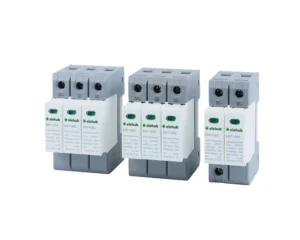
Together, these protection systems ensure fast fault isolation, system-wide electrical safety, and improved operational resilience.

Why Choose ELEHUB for Data Center Applications
ELEHUB’s electrical components are engineered to deliver measurable efficiency gains and long-term reliability in demanding environments. Key advantages include:
- Reduced Power Loss: Optimized designs minimize energy waste across switching and protection systems.
- High Reliability: Stable performance ensures continuous operation in critical applications.
- Precision Monitoring: Advanced components enable real-time energy tracking and smarter decision-making.
- Scalable Applications: Ideal for data centers, AI computing infrastructure, EV charging systems, and renewable energy integration.
Get Started with ELEHUB!
Whether you are upgrading an existing facility or building a next-generation energy-efficient data center, ELEHUB provides the components and expertise to support your goals.
Contact ELEHUB today to explore customized solutions that improve efficiency, enhance reliability, and reduce operational costs.
Conclusion
Data center efficiency is not only a technical requirement but also a critical factor for sustainable and cost-effective operations. With increasing energy demands and environmental concerns, industries must adopt energy optimization strategies such as advanced cooling systems, efficient power distribution, renewable energy integration, and precise monitoring.
By incorporating high-quality components and advanced solutions, data centers can significantly enhance system reliability and performance. Components such as DC shunts enable accurate current monitoring, while high-voltage and universal DC contactors ensure safe and efficient power switching.
Additionally, DC fuses and hydraulic magnetic circuit breakers provide strong protection against overcurrent and electrical faults. Surge protection devices safeguard sensitive equipment from voltage spikes.
These components collectively help reduce energy losses, improve system stability, and support efficient power management across data center infrastructure.
Furthermore, the integration of AI-driven automation and carbon-neutral design approaches is enhancing data center efficiency, enabling organizations to meet growing digital demands while minimizing environmental impact.
❓ FAQs
What is a good PUE for a data center?
A good Power Usage Effectiveness (PUE) value ranges between 1.1 and 1.3, which indicates a highly efficient data center with optimized cooling and power systems.
How much power does an AI data center use?
AI data centers typically consume tens to hundreds of megawatts continuously. Large hyperscale facilities can use hundreds of MWh daily, with total demand reaching gigawatt-scale for advanced AI training clusters.
What is the biggest energy consumer in data centers?
IT equipment and cooling systems together account for over 80% of total consumption.
How to prevent power issues at your data center?
Prevent power issues using:
- Redundant UPS systems
- Real-time energy monitoring
- Load balancing, surge protection
- Preventive maintenance
Ensure stable grid connection and backup generators for continuous uninterrupted operation.
What happens if a data center loses power?
Power loss can cause:
- Server downtime
- Data corruption
- Service outages
- Financial losses
- Potential hardware damage
Redundant systems and backup power are critical to avoid operational disruption.
How to implement redundant power supply in data center?
Implement redundancy using:
- N+1 or 2N UPS systems
- Dual power feeds
- Backup generators
- Independent power distribution paths
This ensures continuous operation even during equipment or grid failure.
Who pays for data center electricity?
Data center electricity is typically paid for by operators or colocation providers. Costs are included in service fees charged to clients based on power usage, rack space, or allocated resources.


