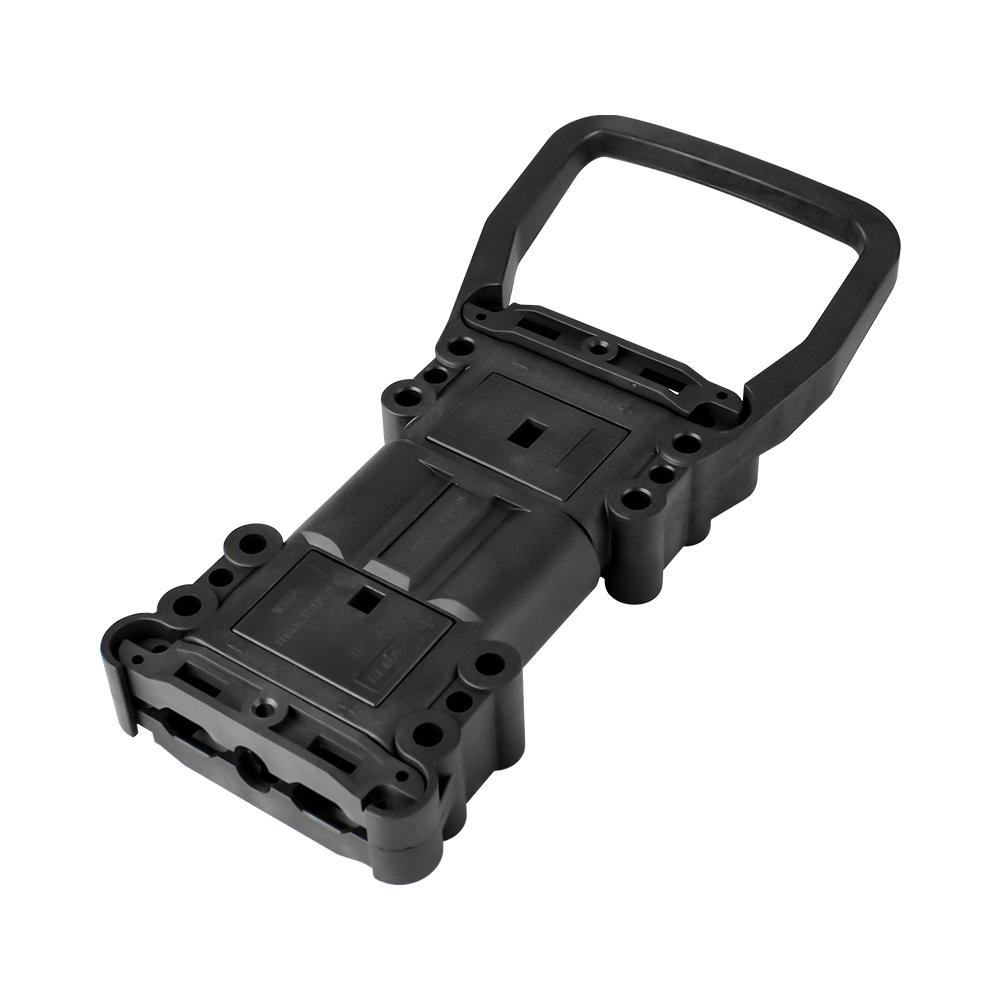
Golf carts were originally designed for golf courses but are now widely used in resorts, communities, airports, and industrial facilities. As electric golf carts become more popular, reliable electrical components are essential. One key component is the golf cart solenoid, also known as a golf cart contactor, which controls power flow between the battery and motor.
Proper understanding of the solenoid’s function, types, testing methods, and replacement procedures is essential for maintaining smooth and safe operation of the cart.

What Is a Solenoid on a Golf Cart?
The golf cart solenoid, also known as the golf cart contactor, is a small component that is considered an important part of the electrical system of golf carts. Typically cylindrical or rectangular, it has three or four terminals. It acts like a bridge between low-power control circuits and high-power drive systems.
In simple terms:
-
The solenoid allows a small control signal from the accelerator or key switch to manage large currents flowing to the motor.
-
It ensures the motor receives power only when needed and protects switches and wiring from damage caused by high current.
-
When the accelerator is pressed, the solenoid closes the circuit to the motor; when released, it disconnects power, preventing overheating or electrical damage.
Without a functioning solenoid, even a fully charged battery cannot move the golf cart.
What Does a Solenoid Do in a Golf Cart?
The main operation of a solenoid is to switch power on and off, and it works based on the principle of electromagnetism. Here’s a simplified explanation:
When the accelerator pedal is pressed:
- A small electrical signal travels through the control wire connected to the solenoid terminals.
- This small current energizes the coil inside the solenoid and turns it into an electromagnet.
- The magnetic field then pulls the metallic plunger toward the coil.
- As the plunger moves, it closes the heavy copper contacts of the larger terminals.
- Once the contacts connect, a high current from the battery flows to the motor, allowing the golf cart to start moving.
When the accelerator pedal is released:
- The control signal stops.
- The magnetic field inside the coil disappears.
- A spring pushes the plunger back to its original position.
- This action separates the connection between the large terminals and stops the power flow to the motor.
The entire process occurs in milliseconds, allowing the golf cart to respond instantly when the pedal is pressed or released.
Because the solenoid operates frequently whenever the accelerator is used, it experiences continuous mechanical and electrical stress. Over time, its internal contacts may burn, the coil may become damaged, or the plunger may stick. For this reason, solenoid failure is a common cause of golf cart electrical problems.
Where the Solenoid Is Located in a Golf Cart
The golf cart solenoid is located in the compartment close to the battery pack or motor controller. It is placed at this point because the component connects directly to the main power cables that carry high current.
- In some electric golf carts, the solenoid is located close to the controller housing or battery pack.
- In gas golf carts, it is connected near the starter generator to control the power flow required for engine starting.
The connection point can vary by model and type, but it is typically located under the seat because the battery and most electrical components are located there.
The solenoid is an important component when troubleshooting a non-moving cart; that is why it is connected at these points for easy maintenance.
Solenoids occasionally require replacement, so placing them close to other electrical components makes them easier to inspect and helps in finding faults.
If the cart is not starting or produces clicking noises without movement, the solenoid connection point can help in checking the wiring connections and voltage levels.
Why the Solenoid Is Important for Golf Cart Operation
If the solenoid does not exist, the golf cart’s electrical system will not operate properly. Motors use high current, often hundreds of amperes, during acceleration. Routing this power through small switches or wiring can result in overheating, damaged components, and potential fire hazards.
The solenoid manages this issue by operating like a heavy-duty electrical relay. It allows small control signals to manage high currents safely. It also protects the electrical system and ensures smooth acceleration and reliable performance.
Another function of the solenoid is circuit isolation. When the cart is not operating, the solenoid disconnects the motor from the battery pack, which prevents battery drain. This helps increase battery life and improves overall efficiency.
Types of Golf Cart Solenoids / Contactors
Understanding the different types helps owners troubleshoot issues, select the right replacement, and ensure the reliable operation of their golf cart:
By Duty Cycle
Continuous Duty Solenoids
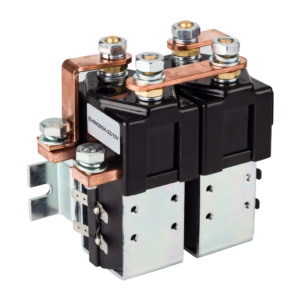
A continuous-duty solenoid is commonly used in electric golf carts. This type of solenoid is designed to remain energized for a long time while the cart is operating. Electric carts use a constant power flow from the battery pack to the motor during driving, so a solenoid is needed to stay closed while the cart is running.
These solenoids come with heavy-duty contacts and durable coils that can handle high electrical loads. Some models have ratings of 200 to 400 amps or more, depending on the motor and controller specifications.
Continuous-duty solenoids are often used in modified golf carts that have upgraded controllers or high-voltage battery systems. In such cases, manufacturers recommend using heavy-duty solenoids to prevent overheating and possible damage.
Since this solenoid operates continuously during driving, it experiences wear over time. The internal contacts can slowly degrade due to electrical arcing, which may eventually cause solenoid failure.
Intermittent Duty Solenoids
Intermittent-duty solenoids are used in gas-powered golf carts. Compared to electric models, gas carts use a solenoid only during the engine-starting process.
When the accelerator pedal of a gas golf cart is pressed, the solenoid connects the battery to the starter generator. Once the engine starts running, the solenoid disengages because the starter is no longer needed.
These solenoids are designed for short bursts of high current rather than continuous operation.
They are smaller in size and lower in cost compared to continuous-duty models, but are still important for engine starting. If the intermittent-duty solenoid fails, the engine will not crank, making the cart difficult to start.
By Function
Golf Cart Reversing Contactor
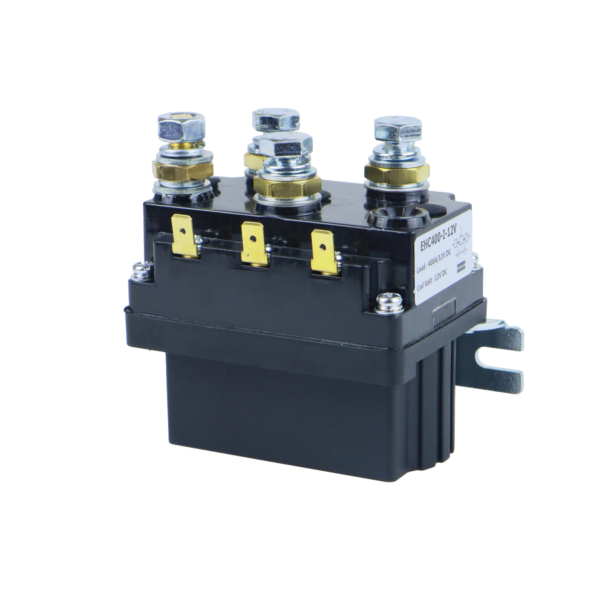
Reversing contactors are used in electric golf carts to provide forward and reverse motor control. They enable the motor to change direction by safely switching the battery connection, ensuring smooth and reliable operation when shifting between forward and reverse.
These golf cart forward reverse solenoid are commonly found in electric carts with 36V and 48V systems. Key features include a dual solenoid configuration, the ability to control the direction of motor rotation, and a typical location near the motor controller for efficient wiring and easy maintenance.
Battery (Main) Contactor
The battery or main contactor connects and disconnects the main battery pack from the golf cart’s electrical system. It functions as a high-current switch, ensuring the cart remains electrically isolated when not in use, which prevents battery drain and protects the system from potential damage.
These contactors are typically continuous-duty rated and can handle currents ranging from 200A to 400A, making them suitable for both 36V and 48V systems.
Heavy-duty models are often used in lifted or high-performance carts, where greater current capacity and durability are required.
By Terminal Count
3-Terminal Solenoids
Three-terminal solenoids are used in specific applications where the mounting bracket grounds the solenoid. They are typically found in older or specialized golf cart models and offer a simplified design that relies on proper grounding.
4-Terminal Solenoids
Four-terminal solenoids are the most common type, featuring two large terminals and two small terminals:
- Large terminals – handle high-current power from the battery.
- Small terminals – control the operation of the accelerator switch signal
This design is standard in modern electric and hybrid golf carts, providing reliable switching and easy integration.

By Voltage:
- 12-Volt Solenoids: Often used in gas-powered golf carts for the starter generator (e.g., Yamaha G2-G20).
- 24-Volt Solenoids: Mid-range applications.
- 36-Volt Solenoids: Common in older or standard E-Z-GO and Club Car electric models.
- 48-Volt Solenoids: Standard for modern Club Car Precedent, DS, and E-Z-GO RXV electric carts.
Electric vs Gas Golf Cart Solenoids
| Feature | Electric Golf Cart Solenoid | Gas Golf Cart Solenoid |
| Function | Controls power flow from the battery pack to the motor controller and motor | Delivers power from the battery to the starter generator for engine starting |
| Type of Duty | Continuous duty (energized while the cart is moving) | Intermittent duty (only during engine start) |
| Operating Principle | Uses an electromagnetic coil to close a high-current connection and deliver power to the motor | Uses an electromagnetic coil to engage the starter circuit temporarily |
| Voltage Rating | 36V or 48V, according to the battery system | 12V, standard for gas carts’ starting system |
| Current Capacity | High current capacity, 200–400A or more | Low current capacity, 100–200A |
| Activation Trigger | Operated when the accelerator pedal is pressed | Activated when the accelerator pedal or ignition system triggers the starter |
| Operation Duration | Remains engaged while the cart is running | Engages for a few seconds during engine start |
| Location in Cart | Usually near the battery pack or motor controller under the seat | Near the starter generator or engine compartment |
| Terminals | 4 terminals (2 large power + 2 control terminals) | 3 or 4 terminals, depending on design |
| Role in Power System | Main high-power switch between batteries and motor | Starter relay connecting battery to starter generator |
| Heat Generation | Handles continuous heat and electrical load | Short bursts of current, less continuous heat exposure |
| Failure Symptoms | Clicking sound but cart won’t move, delayed acceleration, intermittent movement | Engine will not crank or start, no clicking sound from the starter |
| Maintenance Needs | Periodic inspection due to constant use | Less wear due to short operation time |
| Replacement Frequency | Frequent due to continuous duty | Less frequent than electric carts |
| Typical Cost Range | Higher due to heavy-duty design | Lower due to simpler design |
| Compatibility Requirements | Battery voltage and controller system | Starter generator voltage and ignition system |
Brand-Specific Solenoid Compatibility Guides
Aftermarket parts are produced by third-party manufacturers rather than the original equipment company. They are designed to replace or improve OEM components while offering additional benefits for cost, performance, and compatibility.
Golf Cart Solenoid Compatibility by Brand
| Feature / Brand | Club Car
|
EZGO
|
Yamaha
|
| Cart Series | Precedent, DS | RXV, older 36V/48V models | Gas carts (G2–G20, etc.) |
| Voltage | 36V / 48V | 36V / 48V | 12V |
| Duty Type | Continuous-duty | Continuous-duty | Intermittent-duty |
| Terminal Count | 4 | 4 | 3–4 |
| Current Handling | 200–400A | 200–400A | Short bursts for engine cranking |
| Main Function | Smooth motor operation | Reliable motor/controller switching | Starter generator activation |


Benefits of Aftermarket Solenoids Over OEM
- Cost-Effective: Aftermarket solenoids typically cost less than OEM parts, making them ideal for fleet operators, repair shops, and individual users without compromising performance.
- High Compatibility: ELEHUB solenoids are designed to fit multiple golf cart brands, reducing the need to stock brand-specific OEM components.
- Enhanced Performance: Heavy-duty contacts, durable coils, and high-quality materials improve heat tolerance, longevity, and current handling—especially in high-performance or upgraded carts.
- Quick Availability: Readily available in bulk or wholesale, aftermarket solenoids reduce repair lead times and minimize downtime.
- Flexibility for Upgrades: Supports custom battery and motor systems, including high-current continuous-duty applications, offering more flexibility than standard OEM parts.
- Wholesale & Bulk Options: Service centers, distributors, and fleet operators benefit from economical wholesale pricing for inventory or resale.
ELEHUB DC Solenoid & Contactor Solutions
ELEHUB DC solenoids and contactors are engineered to provide reliable performance across major golf cart brands, including Club Car, EZGO, and Yamaha.
For businesses, repair shops, and distributors seeking dependable DC contactor and solenoid solutions, ELEHUB offers a range of wholesale golf cart contactors:
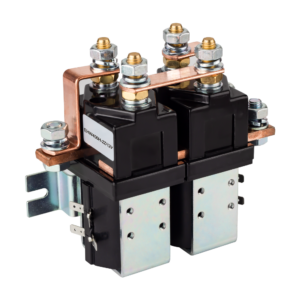
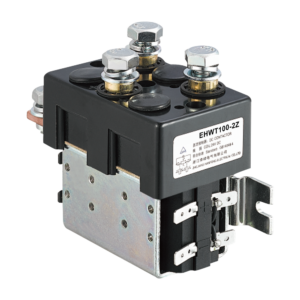
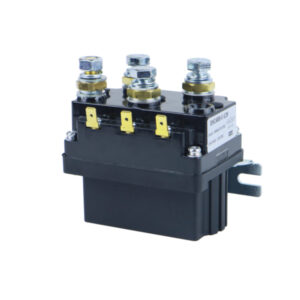
DC Golf Cart Reversing Contactors
Used for forward and reverse motor direction control in EVs and industrial devices. These contactors provide stable switching operation and are suitable for high-current DC applications.
| Model |
EHW Series
|
EHWT Series
|
EHC Series
|
| Rated Contact Current | 100A / 200A / 400A | 100A / 200A | 200A / 300A / 400A |
| Max Contact Switching Voltage | ≤48VDC | ≤48VDC | ≤48VDC |
| Rated Coil Voltage | 12V / 24V / 48VDC | 12V / 24V / 48VDC | 12V / 24V / 48VDC |
| Contact Arrangement | DPDT Changeover | DPDT Changeover | DPDT Changeover |
| Working Duty | Continuous | Continuous | Intermittent |
Universal DC Contactors for Golf Cart Batteries
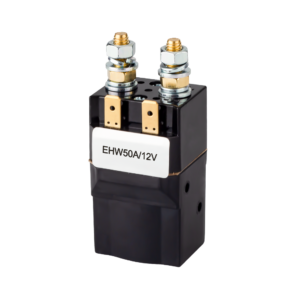
Used for different DC switching operations, such as golf carts, battery-operated machines, and motor control systems.
| Model |
EHW Series
|
EHW-2 Series
|
EHJ Series
|
| Rated Contact Current | 50A / 100A / 200A / 400A / 500A / 600A / 800A | 100A / 200A | 100A / 200A / 400A / 600A / 800A |
| Max Contact Switching Voltage | ≤48VDC (50A); ≤80VDC (100–800A) |
≤80VDC | ≤80VDC |
| Rated Coil Voltage | 12V / 24V / 48VDC (50A); 12V / 24V / 48V / 72VDC (100–800A) |
12V / 24V / 48V / 72VDC | 12V / 24V / 48V / 72VDC |
| Contact Arrangement | SPST-NO | DPDT-NO | SPST-NO |
| Working Duty | Continuous | Continuous | Continuous |
| Magnetic Latching | Optional | Optional | No |
| Auxiliary | Micro Switch (Optional) | Micro Switch (Optional) | No |
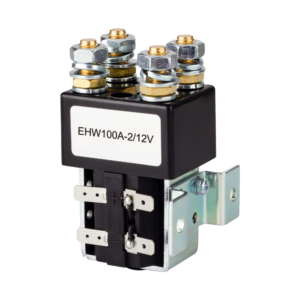
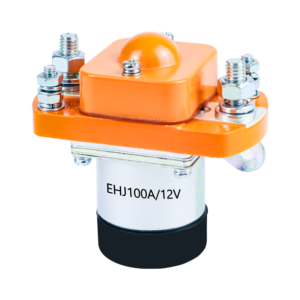
Using high-quality ELEHUB components ensures safe electrical flow, long-term durability, and reliable system performance. Whether upgrading electric carts or replacing worn parts in gas-powered models, selecting the correct voltage, current rating, and duty type guarantees seamless integration.
Golf Cart Solenoid Wiring Diagrams
Golf cart solenoids are typically 3-terminal or 4-terminal, each with a specific wiring and function. Correct wiring ensures reliable starting, motor operation, and safety.
For 3-Terminal Solenoids
A 3-terminal solenoid is typically wired so that the mounting bracket acts as the ground.
- Large Terminal 1: Connects to the battery positive (+).
- Large Terminal 2: Connects to the motor or starter, allowing current flow when energized.
- Small Terminal: Receives the activation signal from the key switch or accelerator.
For 4-Terminal Solenoids
Large Terminal 1
This terminal makes a direct connection with the positive terminal of the golf cart battery. Its main function is to provide the main high-current power required to run the motor.
When the solenoid operates, power flows through it toward the motor controller.
This terminal is connected with a thick, heavy-duty cable and carries the full battery voltage.
If the connection is loose or corroded, the cart may not start.
Large Terminal 2
This terminal is connected to the motor controller or starter circuit of the golf cart. It receives power from the battery when the solenoid is activated.
It delivers current to the motor controller, which then operates the motor. It also uses a heavy cable because it carries high current.
If the solenoid is working properly, this terminal becomes energized when the accelerator is pressed.
Small Terminal 1
This terminal receives the control signal from the ignition or key switch. It provides the activation voltage for the solenoid coil. When the key is turned ON, voltage is sent to this terminal.
It uses a thin control wire. Without voltage at this point, the solenoid will not operate.
If the key switch is not working properly, the cart will not start.
Small Terminal 2
This terminal connects to the throttle microswitch or accelerator switch. Its main function is to complete the circuit that energizes the solenoid coil.
The solenoid activates when the accelerator pedal is pressed. This prevents the motor from running until the pedal is pressed, acting as a safety control.
How to Test a Golf Cart Solenoid
The steps used for testing the golf cart solenoid are discussed below.
- First, arrange a multimeter and a 1/2″ wrench.
- Then disconnect the wires connected to the large terminals. Keep these wires at a safe distance.
- Set the multimeter to the ohms setting and connect the probes to the large terminals while the key is OFF and the cart direction is set to neutral.
- Turn the key ON and press the accelerator with the cart set to the forward position. As a result, a clicking sound should be heard from the solenoid.
- When you hear the click, keep the meter set to ohms and place the probes on the large terminals. The reading should be between 0 and 0.4 ohms. If the value is higher than this range, the solenoid should be replaced.
- If the solenoid does not click, set the multimeter to DC volts on the 200V scale and connect the probes to the small terminals.
- Press the accelerator with the key ON and the cart in the forward position. If the voltmeter shows full battery voltage but the solenoid does not click, the solenoid needs to be replaced.
- If the meter shows zero voltage, it means there is a fault elsewhere in the cart’s electrical system.
How to Bypass Golf Cart Solenoid (Temporary Test)
Bypassing the golf cart solenoid is a temporary test used to determine if the solenoid is faulty. In this method, the two large terminals of the solenoid are connected using a heavy cable or an insulated screwdriver.
When the terminals are connected, battery power flows directly to the motor instead of passing through the solenoid.
If the golf cart moves, it means the solenoid is faulty.
If the cart still does not move, the problem may be in the battery, controller, motor, or wiring.
This test should only be performed for a short time because bypassing the solenoid removes electrical protection and can cause overheating, sparks, or damage to components.
Bad Golf Cart Solenoid Symptoms & Troubleshooting Guide
The golf cart solenoid controls battery power to the motor. If power is not flowing, the cart will not operate well. Below are common symptoms, possible causes, and troubleshooting tips:
| Symptom | Possible Cause | Troubleshooting |
| Clicking sound but the cart won’t move | Damaged internal contacts | The solenoid coil is working, but the heavy-duty contacts are burned or worn, preventing current flow to the motor. Inspect and replace the solenoid if necessary. |
| No clicking sound | Solenoid failure or wiring fault | The coil may be damaged or the wiring to the solenoid may be loose or broken. Check wiring connections and test the solenoid coil for continuity. |
| Intermittent operation | Loose wiring or damaged contacts | Inconsistent connection causes the cart to operate sporadically. Inspect and tighten connections, or replace the solenoid if contacts are worn. |
| Solenoid overheating | Excessive current flow or electrical load | High amperage or prolonged use can cause the solenoid to overheat. Ensure the solenoid rating matches the motor/controller system and check for electrical shorts. |
Golf Cart Solenoid Replacement
Replacement of the solenoid is an easy process. Follow these steps:
- First, turn off the cart and disconnect the battery pack.
- Label all the wires connected to the solenoid.
- Remove the mounting bolts and install the new solenoid.
- Reconnect the wires to the correct terminals.
Make sure the replacement solenoid has the same voltage and current rating as the original unit.
Conclusion
The golf cart solenoid is a small but important component for the operation of a golf cart. It works as a high-power electrical switch that controls the current flow from the battery to the motor. If the solenoid does not work properly, the cart will not deliver power to the motor, and the cart will not move.
With a proper understanding of how the solenoid works, early detection of failure signs, and basic testing or replacement methods, costly repairs and further damage can be avoided. Whether you are using an electric or gas golf cart, keeping the solenoid and wiring in good condition ensures smooth acceleration and safe operation.